
Industrial Panel AC Specifications: 9 Key Checks Before You Buy
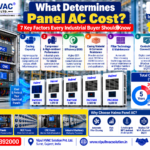
Choosing the right industrial panel AC specifications is essential for protecting electrical control panels, PLC cabinets, VFD panels, MCC panels and industrial automation equipment from excessive heat. A suitable panel air conditioner helps maintain the required enclosure temperature and supports reliable operation in demanding industrial environments.
However, comparing panel air conditioners only by their advertised cooling capacity can lead to the wrong selection. Buyers should also evaluate operating ambient temperature, electrical supply, energy efficiency, enclosure protection, filtration, temperature controls, condensate management and installation requirements.
Vipul HVAC Solution Pvt Ltd helps industrial customers evaluate panel cooling requirements for manufacturing plants, process industries, automation systems and electrical enclosures.
This guide explains the key specifications to check when comparing conventional industrial panel air conditioners and Haima Panel AC models.
What Is an Industrial Panel AC?
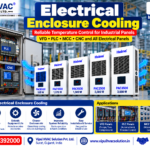
An industrial panel air conditioner is a dedicated cooling unit designed to remove excess heat from electrical enclosures and control cabinets. Unlike a room air conditioner, it is designed for enclosure-mounted applications and the thermal requirements of industrial electrical and electronic components.
Typical applications include:
- Variable Frequency Drive (VFD) panels
- Programmable Logic Controller (PLC) cabinets
- Motor Control Centre (MCC) panels
- CNC machine control cabinets
- SCADA and industrial automation enclosures
- Packaging and production machinery
- Electrical distribution and process-control panels
Many panel AC designs use separate internal and external air circuits. The internal circuit cools the cabinet air, while the external circuit releases heat into the surrounding environment. This arrangement helps prevent untreated ambient air from being deliberately circulated through the enclosure.
The actual level of protection depends on the complete unit design, cabinet sealing, installation quality and specified ingress protection rating.
1. Cooling Capacity: The Most Important Panel AC Specification
Cooling capacity indicates how much heat an air conditioner can remove under specified operating conditions. It is commonly expressed in watts (W), kilowatts (kW), or British thermal units per hour (BTU/h).
For reference:
- 1 kW = 1,000 W
- 1 W ≈ 3.412 BTU/h
- 1,000 W ≈ 3,412 BTU/h
The cooling capacity must be sufficient for the enclosure’s heat load at the expected operating conditions.
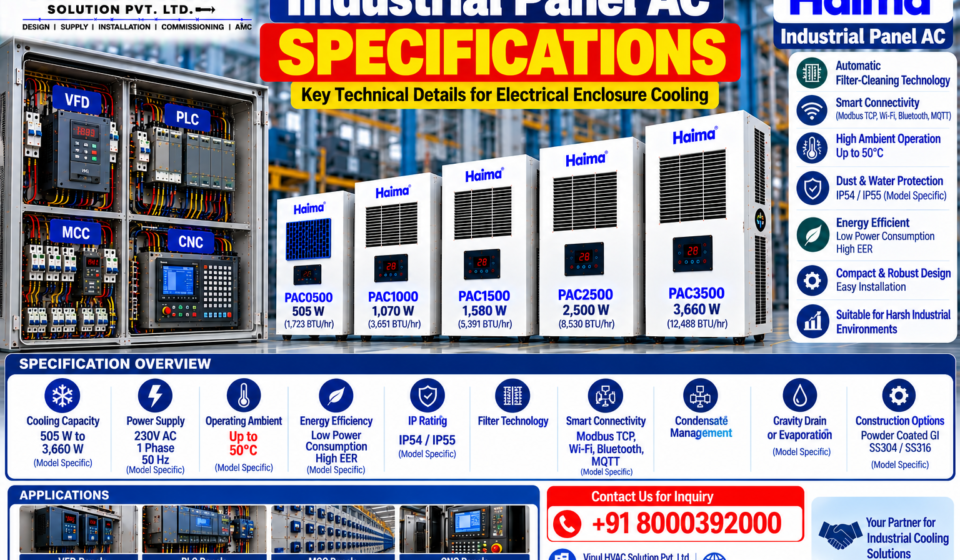
Haima Panel AC models and published cooling capacities
Haima’s official product information lists the following PAC-series cooling capacities.
| Haima model | Published cooling capacity | Approximate capacity in BTU/h |
|---|---|---|
| PAC0500 | 505 W | 1,723 BTU/h |
| PAC1000 | 1,070 W | 3,651 BTU/h |
| PAC1500 | 1,580 W | 5,391 BTU/h |
| PAC2500 | 2,500 W | 8,530 BTU/h |
| PAC3500 | 3,660 W | 12,488 BTU/h |
Source: Haima official industrial panel AC product range.
Important: These are published model ratings, not a guarantee of the same cooling output at every ambient temperature. Haima’s general overview describes the range as approximately 500–3,500 W, while its detailed product listing specifies 3,660 W for PAC3500. Confirm the latest model-specific datasheet, test conditions and availability before purchasing.
Rated capacity versus actual operating capacity
Panel AC performance can vary with the temperature inside the enclosure and the temperature surrounding the condenser.
For example, a cooling capacity stated at an internal and external air condition of 35°C should not automatically be assumed to apply when the external ambient temperature reaches 45°C or 50°C.
Before comparing models, ask the manufacturer or supplier for:
- Cooling capacity at the specified test conditions
- Performance at your maximum site ambient temperature
- Permitted continuous operating ambient temperature
- Electrical power consumption at the same conditions
- Any required derating or operating limitations
Do not apply a generic percentage reduction to every model. Use verified performance data for the exact unit.
2. Operating Ambient Temperature
The maximum operating ambient temperature specifies the environmental temperature within which the panel AC is designed to operate.
This is especially important in Indian industrial environments, where electrical enclosures may be installed in hot factory sheds, outdoor equipment areas, boiler rooms or locations with limited ventilation.
When checking this specification, distinguish between:
- Ambient temperature: The air surrounding the cooling unit.
- Internal enclosure temperature: The air inside the electrical cabinet.
- Maximum rated ambient: The highest ambient temperature permitted by the manufacturer’s stated operating conditions.
Do not assume that every industrial panel AC can operate continuously at 50°C or 55°C. Haima’s published product information states that its units are designed for ambient temperatures up to 50°C. Verify the precise conditions and model-specific limits before final selection.
What to ask before ordering
- What is the maximum permitted ambient temperature?
- What cooling capacity is available at the expected ambient?
- Is continuous operation permitted at that temperature?
- Are special clearances or ventilation conditions required?
- Does the application involve direct sunlight, hot exhaust air or restricted airflow?
For Gujarat plants and other hot-weather installations, use realistic site conditions rather than relying only on average outdoor temperatures.
3. Electrical Supply and Power Consumption
The electrical supply is another essential item in industrial panel AC specifications.
Before purchasing, confirm the following from the model’s datasheet:
- Rated supply voltage
- Single-phase or three-phase supply
- Supply frequency
- Rated current and maximum current
- Electrical power input
- Recommended circuit protection
- Earthing and wiring requirements
Do not assume that every panel AC uses 230 V AC, single-phase, 50 Hz. The correct supply depends on the selected model and its configuration.
Also, do not confuse cooling capacity with electrical power consumption. A unit providing 1,580 W of cooling does not necessarily consume 1,580 W of electrical power.
The electrical supply and protection must be suitable for the selected unit and the installation. Follow the manufacturer’s wiring diagram and the plant’s electrical safety procedures.
4. Energy Efficiency Ratio (EER)
Energy Efficiency Ratio, or EER, indicates the relationship between cooling output and electrical power input at the specified rating conditions.
Formula:
EER = Cooling capacity (W) ÷ Electrical power input (W)
For example, if a panel AC provides 1,500 W of cooling while consuming 700 W of electrical power:
EER = 1,500 ÷ 700 = approximately 2.14
A higher EER generally indicates more cooling output per watt of electricity at the same rating conditions. However, EER comparisons are meaningful only when the models are rated under comparable conditions.
Estimate annual electricity cost
Use this formula:
Annual electricity cost = Power input (kW) × Operating hours per year × Electricity tariff per kWh
For example, assume a panel AC consumes 0.70 kW, operates for 8,000 hours per year and electricity costs ₹9.50 per kWh.
Annual cost = 0.70 × 8,000 × ₹9.50 = ₹53,200
This is an illustrative estimate, not a verified consumption figure for a particular Haima model. Actual costs depend on measured power draw, operating conditions, compressor cycling and the electricity tariff.
For an accurate comparison, use each model’s published power input under the same conditions.
5. IP Rating and Closed-Loop Cooling
The ingress protection (IP) rating describes protection against access to hazardous parts and the ingress of solid objects and water under specified test conditions.
The required rating depends on the installation environment.
| Rating to evaluate | General meaning |
|---|---|
| IP54 | Limited dust ingress protection and protection against water splashes under specified test conditions |
| IP55 | Dust protection and protection against water jets under specified test conditions |
| IP65 | Dust-tight enclosure and protection against water jets under specified test conditions |
These ratings are not interchangeable, and a higher rating does not automatically make a unit suitable for every industrial environment.
Check the complete installed assembly. The rating of an empty electrical cabinet may not remain valid after cutting a mounting opening and installing a panel AC. Confirm the rating of the complete arrangement, including seals, gaskets, mounting hardware and the cooling unit.
For food-processing washdown, pharmaceutical, chemical or corrosive environments, confirm the specific cleaning method, chemical exposure, corrosion resistance and installation requirements. Do not assume IP55 alone makes a product suitable for high-pressure washdown or hazardous-area use.
6. Filter Technology and Maintenance Requirements
Dust, fibres, oil mist and other airborne contaminants can affect the external heat exchanger of a panel AC. Contamination can restrict airflow and reduce heat rejection, potentially affecting cooling performance.
When evaluating filter specifications, check:
- Filter type and construction
- Suitability for the actual contaminants
- Cleaning or replacement procedure
- Maintenance interval recommended by the manufacturer
- Access for inspection and servicing
- Availability of replacement parts
Haima Panel AC and automatic filter cleaning
Haima promotes an automatic air-filter-cleaning mechanism as a key feature of its industrial panel AC range. The technology is intended to help manage filter clogging and reduce manual filter-cleaning work.
Potential benefits include less routine manual filter cleaning and support for consistent airflow when the system operates as designed. Actual results depend on the site environment, contamination type, operating conditions and the manufacturer’s maintenance instructions.
Automatic filter cleaning does not mean that the entire panel AC is maintenance-free. The cooling unit should still be inspected and serviced according to the current product documentation.
Read more: Haima Industrial Panel AC for PLC.
7. Temperature Controller, Alarm Outputs and Connectivity
Industrial panel AC specifications should explain how the unit monitors and controls cabinet temperature.
Check for the following features, where required:
- Digital temperature display
- Adjustable temperature setpoint
- Temperature sensor and control accuracy
- Compressor switching differential or hysteresis
- High-temperature alarm
- Fault indication
- Relay or dry-contact alarm output
- Communication interface for plant monitoring
A potential-free relay contact, if provided, can be used to send a fault or alarm signal to a PLC or other monitoring system. Confirm the available contact type, electrical rating, alarm conditions and wiring requirements.
Haima smart monitoring features
Haima advertises built-in Modbus TCP, Wi-Fi, Bluetooth and MQTT connectivity across its product range. These features may be useful for monitoring and integration, but buyers should confirm the exact interfaces, supported data points, network requirements and alarm functions on the selected model.
For SCADA or PLC integration, request the communication documentation before finalising the control-panel design.
8. Condensate Management and Installation
Moisture can condense on the evaporator when the coil temperature falls below the dew point of the air passing over it. A panel AC specification should clearly state how this condensate is collected and managed.
Common arrangements include:
Gravity drainage: Condensate leaves through a drain connection. The installer must follow the manufacturer’s requirements for routing, slope, discharge location and inspection.
Condensate evaporation: Some units use a system designed to evaporate collected water. Confirm whether the selected model includes this feature and the operating conditions under which it works.
Do not assume that every panel AC includes active condensate evaporation or that an external drain is never required.
Installation checks
- Follow the specified mounting orientation and cut-out dimensions.
- Keep the air inlet and outlet clear.
- Maintain the required clearance around the condenser.
- Route condensate away from electrical components.
- Inspect seals and gaskets after installation.
- Confirm that cabinet doors, internal components and wiring do not obstruct airflow.
- Follow the manufacturer’s instructions for servicing and cleaning.
Proper installation is as important as choosing the correct cooling capacity.
9. Enclosure Compatibility, Dimensions and Environmental Conditions
The panel AC must physically and electrically suit the cabinet where it will be installed.
Before ordering, verify:
- Overall dimensions and mounting cut-out
- Weight and mounting arrangement
- Cabinet construction and available space
- Internal and external airflow clearance
- Ambient dust and moisture exposure
- Corrosion risk and material compatibility
- Required cable entry and service access
- Any applicable hazardous-area restrictions
Haima’s official product information lists construction and connectivity features, but buyers should check the exact model documentation for dimensions, materials, mounting requirements and environmental limits.
For chemical plants, refineries and other potentially hazardous locations, obtain explicit confirmation of suitability for the area’s classification. A general industrial panel AC should not be assumed to be explosion-proof or suitable for hazardous areas without the required certification.
Haima Panel AC: Which Model Should You Evaluate?
Haima’s PAC range offers different published cooling capacities for different enclosure heat loads.
| Model | Published cooling capacity | What to evaluate |
|---|---|---|
| PAC0500 | 505 W | Compact, lower-heat-load cabinets |
| PAC1000 | 1,070 W | Small to moderate heat loads |
| PAC1500 | 1,580 W | Moderate heat loads |
| PAC2500 | 2,500 W | Higher heat loads |
| PAC3500 | 3,660 W | Larger or higher-heat-load enclosures |
These descriptions are general guidance, not guaranteed application matches. A model should be selected only after calculating the enclosure heat load and checking the unit’s performance at the expected ambient temperature.
Explore the official Haima product range for published product information.
How to Choose the Right Industrial Panel AC
Use this checklist before requesting a quotation.
- Calculate the heat load: Identify the heat dissipated by drives, power supplies, contactors and other installed components.
- Establish the design temperatures: Record the maximum surrounding ambient temperature and the required internal cabinet temperature.
- Check usable cooling capacity: Obtain the performance rating at the relevant operating conditions.
- Confirm the electrical supply: Verify voltage, frequency, current, power input and circuit protection.
- Select the protection level: Consider dust, water, oil mist, chemical exposure and the complete installed enclosure’s IP requirements.
- Review maintenance needs: Compare filter technology, cleaning access, inspection intervals and service requirements.
- Check controls and communication: Confirm temperature controls, alarms and any required PLC or SCADA interface.
- Verify installation details: Check dimensions, cut-out, mounting orientation, clearance and condensate management.
- Confirm commercial support: Check availability, warranty, technical documentation, service arrangements and spare parts.
A technically suitable panel AC is one that meets the actual application requirements—not simply the unit with the largest model number or lowest purchase price.
Why Consider Vipul HVAC Solution Pvt Ltd?
Vipul HVAC Solution Pvt Ltd supports industrial and commercial HVAC requirements and helps customers evaluate cooling solutions for electrical panels and industrial equipment.
For an industrial panel AC enquiry, prepare the panel dimensions, equipment list, estimated heat load, site ambient temperature, desired internal temperature and installation photographs. These details help make the technical discussion more productive.
Customers considering Haima Panel AC can also confirm the exact model, current availability, specifications, warranty and sourcing arrangements before placing an order.
Request an industrial panel AC enquiry
Call: +91 8000392000
Website: Vipul HVAC Solution Pvt Ltd
Frequently Asked Questions
1. What are the most important industrial panel AC specifications?
The main specifications include cooling capacity, performance at the expected ambient temperature, electrical supply, power input, EER, IP protection, filter design, temperature controls, alarm outputs, condensate management and installation dimensions.
2. What is the cooling capacity of Haima Panel AC?
Haima’s published PAC-series ratings are 505 W, 1,070 W, 1,580 W, 2,500 W and 3,660 W. These correspond to PAC0500, PAC1000, PAC1500, PAC2500 and PAC3500, respectively. Confirm the current model-specific datasheet and rating conditions before selection.
3. Can an industrial panel AC operate at 50°C ambient temperature?
It depends on the model and its published operating limits. Haima’s product information states that its units are designed for ambient temperatures up to 50°C. Confirm the permitted conditions and available cooling capacity for the exact model.
4. What is EER in an industrial panel AC?
EER is the ratio of cooling capacity to electrical power input at specified rating conditions. A higher EER generally means more cooling per watt under comparable conditions.
5. Is Haima Panel AC suitable for PLC and VFD panels?
Haima markets its PAC range for industrial enclosure cooling, including applications such as PLC and VFD panels. The suitable model depends on the heat load, cabinet dimensions, ambient temperature and required internal temperature.
6. Does automatic filter cleaning eliminate all panel AC maintenance?
No. Haima’s automatic filter-cleaning feature is intended to reduce manual filter-cleaning work. Other inspections and servicing may still be required under the manufacturer’s maintenance instructions.
7. Which IP rating is best for an industrial panel AC?
The required rating depends on the dust and water exposure of the installation. Confirm the IP rating of the complete installed cabinet and cooling unit. Special washdown, corrosive or hazardous environments may require additional suitability checks.
8. How do I calculate the required panel AC cooling capacity?
Estimate the heat dissipated by the installed components, evaluate heat entering through the enclosure, and consider the expected ambient and desired internal temperatures. Use manufacturer performance data and qualified engineering guidance to select the final capacity.
9. How can I request an industrial panel AC quotation?
Call +91 8000392000 and share your enclosure dimensions, component heat-load information, maximum site ambient temperature, required internal temperature, installation conditions and preferred model, if known.
Conclusion
Correct industrial panel AC specifications help buyers compare cooling units on engineering suitability rather than headline capacity alone. Cooling performance at the actual ambient temperature, electrical compatibility, enclosure protection, filtration, control features and installation requirements should all be checked before procurement.
Haima Panel AC offers a range of published cooling capacities and advertises automatic filter cleaning and smart connectivity. The final model selection should be based on verified technical documentation and the requirements of the electrical enclosure.
For industrial panel cooling enquiries, contact Vipul HVAC Solution Pvt Ltd at +91 8000392000.