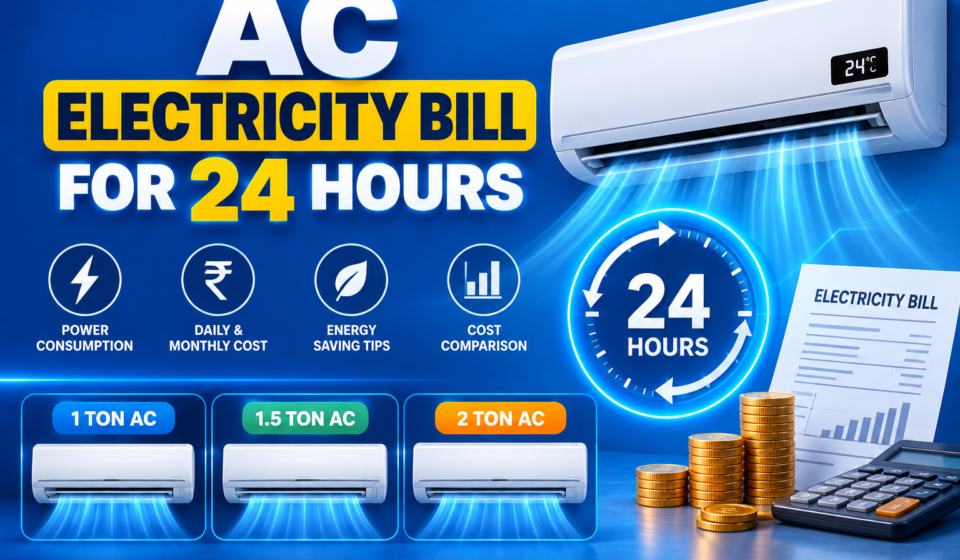

AC Electricity Bill for 24 Hours: Calculate Daily and Monthly Cost
Have you ever wondered how much your electricity bill will increase if you run your air conditioner for 24 hours a day? Whether you use a 1-ton, 1.5-ton or 2-ton AC, understanding electricity consumption can help you manage your monthly household expenses.
The AC Electricity Bill for 24 Hours depends on the air conditioner’s actual power consumption, cooling capacity, inverter technology, room temperature, outdoor weather, insulation and your electricity tariff.
For example, an air conditioner that averages 1,000 watts of power while operating continuously for 24 hours consumes approximately 24 units of electricity per day. At an illustrative rate of ₹8 per unit, that equals ₹192 per day or ₹5,760 for 30 days.
However, this is only an example. Your AC may consume more or less electricity depending on its model and operating conditions.
At VIPUL HVAC SOLUTION PVT. LTD., we understand the importance of selecting suitable air-conditioning systems for residential, commercial and industrial applications. This guide explains how to calculate AC electricity consumption, estimate your daily and monthly bill, compare different AC capacities and reduce unnecessary energy costs.
1. How Much Electricity Does an AC Use in 24 Hours?
Air conditioner electricity consumption is measured in kilowatt-hours (kWh), commonly called electricity units.
One unit of electricity equals 1 kWh.
The formula is:
Electricity consumption (units) = Average power consumption (kW) × Operating hours
For 24-hour operation:
Daily consumption = Average power consumption × 24
For a 30-day month:
Monthly consumption = Average power consumption × 24 × 30
To calculate the electricity cost:
Electricity cost = Units consumed × Electricity rate per unit
For example, if an AC averages 1.2 kW while operating:
- Daily consumption: 1.2 × 24 = 28.8 units
- Monthly consumption: 28.8 × 30 = 864 units
- Monthly energy cost at ₹8 per unit: 864 × ₹8 = ₹6,912
This estimate covers the AC’s energy consumption only. Your actual bill may also include fixed charges, taxes, fuel adjustments, slab-based rates and other applicable charges.
2. Electricity Bill for a 1-Ton AC Running 24 Hours
A 1-ton AC is often used in smaller rooms, depending on the cooling load. Its electricity consumption varies by model, efficiency rating and operating conditions.
For an illustrative calculation, assume the AC averages 0.8 kW while running.
| Calculation | Estimated result |
|---|---|
| Average power input | 0.8 kW |
| Daily operating time | 24 hours |
| Daily electricity consumption | 19.2 units |
| Monthly consumption for 30 days | 576 units |
| Daily cost at ₹8/unit | ₹153.60 |
| Monthly energy cost at ₹8/unit | ₹4,608 |
Important: The 0.8 kW figure is an example, not a guaranteed consumption value for every 1-ton AC. Check your model’s rated input and measure actual consumption for a more accurate estimate.
3. Electricity Bill for a 1.5-Ton AC Running 24 Hours
A 1.5-ton AC is commonly considered for bedrooms, living rooms and suitable small commercial spaces. The correct capacity depends on room dimensions, heat entering the space, occupancy and other factors.
Assume an illustrative average operating input of 1.2 kW.
| Calculation | Estimated result |
|---|---|
| Average power input | 1.2 kW |
| Daily operating time | 24 hours |
| Daily electricity consumption | 28.8 units |
| Monthly consumption for 30 days | 864 units |
| Daily cost at ₹8/unit | ₹230.40 |
| Monthly energy cost at ₹8/unit | ₹6,912 |
Actual consumption can be substantially different. An inverter AC may reduce its compressor power after reaching the set temperature, while a conventional AC may cycle its compressor on and off.
4. Electricity Bill for a 2-Ton AC Running 24 Hours
A 2-ton AC may be suitable for larger rooms or certain commercial spaces when supported by a proper cooling-load calculation.
For this example, assume an average operating input of 1.8 kW.
| Calculation | Estimated result |
|---|---|
| Average power input | 1.8 kW |
| Daily operating time | 24 hours |
| Daily electricity consumption | 43.2 units |
| Monthly consumption for 30 days | 1,296 units |
| Daily cost at ₹8/unit | ₹345.60 |
| Monthly energy cost at ₹8/unit | ₹10,368 |
A 2-ton AC does not always consume exactly twice as much electricity as a 1-ton AC. The actual input power depends on the specific model, efficiency, operating conditions and cooling load.
5. Compare AC Electricity Costs for 24-Hour Operation
The following table compares three illustrative average power inputs using an electricity rate of ₹8 per unit.
| AC capacity | Assumed average input | Daily units | Monthly units | Monthly energy cost |
|---|---|---|---|---|
| 1 ton | 0.8 kW | 19.2 | 576 | ₹4,608 |
| 1.5 ton | 1.2 kW | 28.8 | 864 | ₹6,912 |
| 2 ton | 1.8 kW | 43.2 | 1,296 | ₹10,368 |
These are calculation examples, not manufacturer-specific performance figures or a prediction of your exact bill.
Your AC’s actual average input may be lower or higher. If your tariff is ₹6 per unit instead of ₹8, the energy costs will be 25% lower than those shown. If your effective rate is ₹10 per unit, they will be 25% higher.
6. Calculate Your AC Electricity Bill
Use the following calculator to estimate the electricity cost of running your AC for up to 24 hours daily.
How to use it: Enter the average power input from your AC’s specifications or a reliable energy measurement, your daily operating hours, your electricity rate and the number of days.
The average input should represent actual operating consumption—not automatically the AC’s maximum rated input.
Example calculation
If your AC averages 1.2 kW, runs for 24 hours daily, and electricity costs ₹8 per unit:
- Daily consumption = 1.2 × 24 = 28.8 units
- Monthly consumption = 28.8 × 30 = 864 units
- Monthly energy cost = 864 × ₹8 = ₹6,912
Remember that your final electricity bill may include other charges and tariff adjustments.
7. Does an Inverter AC Consume Less Electricity?
An inverter AC can vary compressor speed to match the cooling demand. Once the room approaches the set temperature, the compressor may operate at a lower speed rather than repeatedly switching fully on and off.
Potential benefits include:
- Lower power consumption under suitable operating conditions.
- More consistent room temperature.
- Reduced temperature fluctuations.
- Improved comfort during long operating periods.
However, an inverter AC is not automatically cheaper to operate in every situation. Performance depends on the model’s efficiency, correct sizing, installation, temperature setting, outdoor conditions and maintenance.
When comparing models, review the applicable energy label, rated power input, efficiency information and manufacturer’s performance data. Do not compare ACs using tonnage alone.
8. What Factors Increase the Electricity Bill When an AC Runs All Day?
High outdoor temperature
When outdoor temperatures rise, an AC may need to remove more heat from the room. This can increase compressor operating time and power consumption.
Incorrect AC capacity
An undersized AC may struggle to meet the cooling demand. An oversized unit can also have drawbacks, including higher purchase costs and potentially less effective humidity control in some conditions.
Low temperature settings
Setting the thermostat much lower than necessary can increase electricity consumption. A practical temperature setting can help balance comfort and energy use.
Poor insulation and air leakage
Open doors, leaking windows, direct sunlight and poorly insulated roofs allow heat to enter the room, increasing the cooling load.
Dirty filters and restricted airflow
Dust on filters can restrict airflow and affect performance. Clean filters according to the manufacturer’s instructions.
Refrigerant or equipment problems
Incorrect refrigerant charge, damaged components or other faults can affect cooling performance and energy consumption. Arrange qualified servicing if the AC is not cooling properly.
Heat from people and appliances
Occupants, computers, cooking equipment, lighting and other heat sources can increase cooling demand.
9. Seven Practical Ways to Reduce Your AC Electricity Bill
1. Set a sensible temperature
The Bureau of Energy Efficiency (BEE), under India’s Ministry of Power, recommends maintaining the AC setting at around 24°C as an energy-saving measure. A higher setting may reduce consumption, depending on the conditions.
2. Clean the air filters
Follow the manufacturer’s cleaning schedule. Clean filters help maintain suitable airflow and indoor comfort.
3. Keep doors and windows closed
Reduce unwanted heat entering the cooled space. Use suitable curtains or blinds where direct sunlight is significant.
4. Select the right AC capacity
Choose capacity based on the cooling load rather than room area alone. Consider ceiling height, windows, occupancy, appliances and local climate.
5. Use timers and operating schedules
For rooms that are not occupied continuously, use timers or controls to avoid unnecessary cooling. If you need continuous operation, use settings appropriate to occupancy and comfort.
6. Schedule preventive maintenance
Regular maintenance can identify dirty coils, drainage issues, airflow restrictions and equipment faults that affect performance.
7. Compare energy labels before purchasing
Look at the applicable BEE star rating and other manufacturer specifications for the model you plan to buy. Compare equipment of similar capacity and operating requirements.
10. Is It Safe to Run an AC for 24 Hours Continuously?
An air conditioner designed for the intended application can often operate for extended periods when correctly installed, maintained and used according to the manufacturer’s instructions.
However, continuous operation increases total operating hours and can increase electricity costs. Check that:
- The AC is correctly sized for the room.
- The electrical supply and protective devices are appropriate.
- Air filters and coils receive required maintenance.
- The condensate drain works correctly.
- The outdoor unit has adequate airflow and clearance.
- Any unusual noise, burning smell, leakage or cooling problem is inspected promptly.
Follow the manufacturer’s operating instructions and use a qualified technician for electrical or refrigerant-related work.
11. Electricity Costs for Commercial AC Systems
Residential split ACs are only one part of the air-conditioning market. Offices, shops, hotels, restaurants, hospitals, factories and other commercial facilities may use multiple indoor units or larger HVAC systems.
VIPUL HVAC SOLUTION PVT. LTD. provides HVAC solutions that include:
- Split and ducted air-conditioning systems.
- Cassette AC systems.
- VRF/VRV systems.
- Chiller systems.
- Air Handling Units (AHUs).
- Fresh-air ventilation and exhaust systems.
- HVAC design and consultancy.
- Installation, testing and commissioning.
- Maintenance and AMC-related services.
For larger buildings, electricity consumption depends on the combined input of all equipment, operating schedules, cooling loads, ventilation requirements, controls and system efficiency.
A commercial HVAC energy assessment can help identify operating patterns and potential improvements. Equipment selection should be based on project requirements rather than an assumption that one system is always the cheapest.
12. Frequently Asked Questions About AC Electricity Consumption
How much electricity does an AC use in 24 hours?
It depends on average power input. An AC averaging 1 kW over 24 hours consumes 24 units. If it averages 0.8 kW, it consumes 19.2 units.
What is the electricity bill for a 1.5-ton AC running 24 hours?
Using an illustrative average input of 1.2 kW and a tariff of ₹8 per unit, the estimated energy cost is ₹230.40 per day or ₹6,912 for 30 days. Your actual bill may differ.
How many units does a 1-ton AC consume per day?
If it averages 0.8 kW for 24 hours, it consumes 19.2 units daily. The actual figure depends on the model and operating conditions.
Does an inverter AC save electricity when used for 24 hours?
An inverter AC can reduce power input when cooling demand falls. Savings depend on the specific model, room conditions, set temperature and usage pattern.
Which AC temperature setting can help reduce electricity consumption?
A setting around 24°C is a useful starting point for balancing comfort and energy use, as recommended by BEE. Personal comfort and room conditions may require adjustments.
Does running an AC at 16°C cool a room faster?
A very low setpoint does not necessarily make the AC cool the room faster. It may keep the compressor working harder for longer, increasing energy consumption.
Is the AC electricity bill the same every month?
No. Outdoor temperatures, usage hours, tariff slabs, occupancy, maintenance and other conditions can change the bill.
How can I calculate my AC electricity bill accurately?
Use a reliable measurement of actual energy consumption where possible, or estimate it using average input power multiplied by operating hours. Multiply the resulting units by your applicable electricity tariff, then account for other bill charges.
Can VIPUL HVAC SOLUTION PVT. LTD. help with commercial HVAC requirements?
VIPUL HVAC SOLUTION PVT. LTD. offers a range of air-conditioning and HVAC solutions. Contact the company to discuss system selection, project requirements and available services.
13. VIPUL HVAC SOLUTION PVT. LTD. Branches Across Gujarat
VIPUL HVAC SOLUTION PVT. LTD. lists eight branch locations on its official website. Customers can contact the appropriate branch or central sales team to discuss air-conditioning and HVAC requirements.
1. Surat – Head Office
Surat is the company’s head-office location and a central contact point for commercial and industrial HVAC enquiries.
Central sales: +91 8000392000
2. Ankleshwar Branch
Address: G-14, G-23-24, Golden Square, Ankleshwar–Valia Road, opposite CNG Pump, near Maruti Showroom, GIDC Chokdi, Ankleshwar, Gujarat 393002.
Sales: +91 8000192000
3. Bharuch Branch
Address: G-8, Bhagvati Enclave, near ABC Circle, Chokdi, Bholav, Bharuch, Gujarat 392001.
Sales: +91 9081309300
4. Vadodara (Baroda) Branch
Address: Rajnagar Society, Tarangan Society, Haripura, Vadodara, Gujarat 390007.
Sales: +91 90990 74214
5. Ahmedabad Branch
Address: 11, Saanvi Nirman Stella, opposite Flora Ixora Road, South Bopal, Ahmedabad, Gujarat 380058.
Sales: +91 7096500050
6. Talala Branch
Address: Shop No. 3, Ajit Chambers, Veraval–Talala Road, near New S.T. Bus Stand, Kailash Nagar, Talala, Gujarat 362150.
Sales: +91 7700046246
7. Junagadh Branch
Junagadh is listed in the company’s official branch directory. Contact central sales to confirm current local contact details and project support arrangements.
Central sales: +91 8000392000
8. Vapi Branch
Vapi is also listed in the company’s official branch directory. Contact central sales for current local contact details and enquiries about available HVAC solutions.
Central sales: +91 8000392000
Official branch directory: https://vipulhvacsolution.in/our-branches/
Email: info@vipulhvacsolution.in
Please confirm current contact details and service availability with the company before visiting a branch.
Contact VIPUL HVAC SOLUTION PVT. LTD.
Whether you need air conditioning for a home, office, showroom, hotel, hospital or industrial facility, selecting the right equipment and maintaining it properly can help manage energy consumption and improve comfort.
Contact VIPUL HVAC SOLUTION PVT. LTD. to discuss your air-conditioning or commercial HVAC project requirements.
Central sales: +91 8000392000
Email: info@vipulhvacsolution.in
Website: https://vipulhvacsolution.in/
Explore the official branch directory or contact page for further information.
VIPUL HVAC SOLUTION PVT. LTD. – Air Conditioning and HVAC Solutions Across Gujarat.