

Panel Cooling for VFD, PLC, MCC and CNC Panels: A Complete Industrial Guide
Why Industrial Panel Cooling Matters
Modern factories depend on electrical control panels to operate machinery, automate production and maintain process reliability. Variable Frequency Drives (VFDs), Programmable Logic Controllers (PLCs), Motor Control Centres (MCCs) and Computer Numerical Control (CNC) systems are essential components of industrial automation.
However, these devices generate heat during normal operation. When heat accumulates inside an electrical enclosure, the internal temperature can rise beyond the recommended operating limits of sensitive electronic equipment. The result may include temperature alarms, VFD tripping, machine downtime, communication faults and premature component degradation.
Effective panel cooling for VFD, PLC, MCC and CNC panels helps maintain suitable operating conditions for electrical and electronic components. Depending on the heat load and environment, suitable solutions may include filtered ventilation, heat exchangers or industrial panel air conditioners.
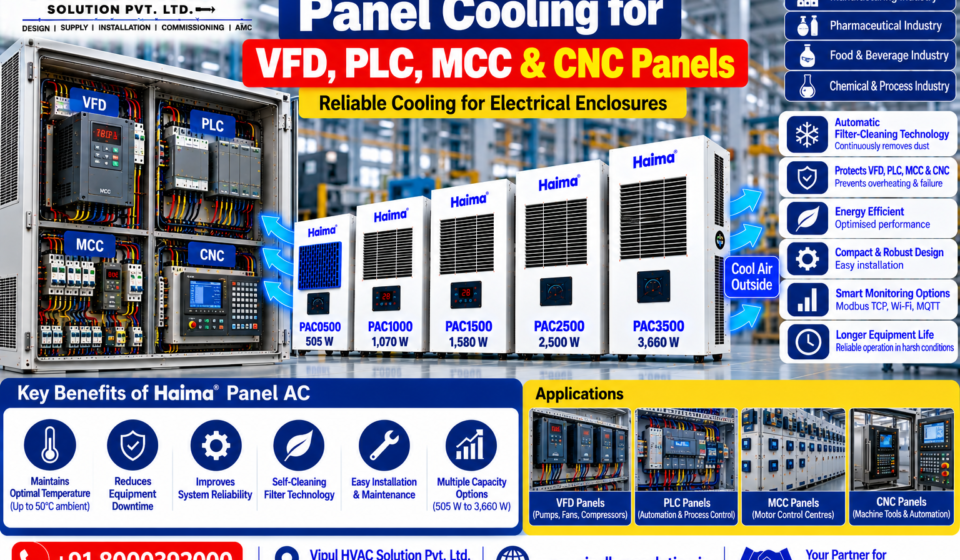
Haima Panel AC is one option to consider when an electrical enclosure requires active cooling. Its published product range includes several cooling capacities and an automatic air-filter-cleaning mechanism designed for industrial enclosure applications.
Vipul HVAC Solution Pvt Ltd supports industrial HVAC product and project enquiries. This guide explains panel cooling methods, application-specific requirements, cooling-capacity selection and the role of Haima Industrial Panel AC.
What Is Industrial Panel Cooling?
Industrial panel cooling is the process of controlling the temperature inside electrical enclosures that contain heat-generating equipment.
A control panel may include drives, controllers, power supplies, transformers, contactors, relays, communication devices and other electronic components. These components release heat as they operate.
If the enclosure cannot dissipate that heat sufficiently, the internal temperature may exceed the specified operating range.
Industrial panel cooling aims to:
- Maintain suitable internal cabinet temperatures.
- Support reliable operation of electrical and electronic equipment.
- Reduce temperature-related alarms and interruptions.
- Help protect sensitive automation components.
- Manage heat in demanding industrial environments.
- Support equipment reliability when combined with correct installation and maintenance.
The required cooling method depends on the heat load, ambient temperature, contamination level, enclosure design and equipment manufacturer’s recommendations.
1. VFD Panel Cooling: Managing Heat from Variable Frequency Drives
Variable Frequency Drives control the speed and torque of AC motors by adjusting their electrical supply. They are widely used in pumps, fans, compressors, conveyors, mixers and industrial machinery.
VFDs generate heat through electrical losses in their power electronics. Additional heat may come from power supplies, reactors, braking components and other equipment installed in the same enclosure.
Common VFD panel cooling challenges
High ambient temperature: Hot factory air reduces the temperature difference available for natural heat dissipation.
Insufficient airflow: Blocked air inlets, incorrect drive mounting or inadequate clearance can interfere with the manufacturer’s cooling arrangement.
Dust accumulation: Filters and cooling surfaces can become obstructed, reducing heat-removal performance.
High drive loading: Drive losses can vary with operating conditions, so the heat load during peak production may differ from the average.
Undersized cooling: A cooling unit that cannot handle the total enclosure load may fail to maintain the required temperature.
How to improve VFD panel cooling
- Obtain the drive’s heat-loss data from its manufacturer.
- Follow the specified mounting orientation and ventilation clearances.
- Check the drive’s permitted ambient temperature and derating requirements.
- Inspect filters, fans and cooling equipment.
- Measure the internal cabinet temperature during peak operation.
- Calculate the complete enclosure cooling load.
- Select an appropriate cooling solution using verified performance data.
Is Haima Panel AC suitable for VFD panels?
Haima Industrial Panel AC is designed for electrical enclosure cooling and can be evaluated for VFD cabinets where active cooling is required.
The correct model must provide sufficient cooling under the expected ambient conditions. It should not be selected solely from the VFD’s electrical rating or the cabinet’s physical size.
Official product information: https://haima.co/product.html
2. PLC Panel Cooling: Protecting Automation Controllers
Programmable Logic Controllers are used to control production sequences, machine operations, sensors, actuators and process equipment.
PLC cabinets may contain the controller, input/output modules, industrial communication devices, power supplies, relays and other electronic components.
Although some PLC systems produce relatively little heat, the total enclosure load can increase when several devices are installed together or when the cabinet operates in a hot environment.
Why PLC panel cooling is important
Excessive temperature can affect the operating conditions of PLCs and associated electronics. Temperature-related problems may contribute to equipment alarms, communication issues or intermittent faults, depending on the device and installation.
A suitable cooling arrangement helps maintain the temperature range specified by the equipment manufacturers.
PLC cooling recommendations
- Check the heat dissipation of the PLC and its associated components.
- Maintain the recommended spacing and ventilation.
- Prevent hot air from circulating back into equipment air inlets.
- Consider ambient dust, moisture and other environmental factors.
- Use active enclosure cooling where natural heat dissipation is insufficient.
- Verify the complete enclosure heat load before choosing a panel AC.
Haima Panel AC can be considered for PLC cabinets that require dedicated refrigeration-based enclosure cooling. The final selection should be based on the actual thermal requirements and the specific product datasheet.
3. MCC Panel Cooling: Managing Heat in Motor Control Centres
Motor Control Centres contain equipment used to control, protect and distribute power to industrial motors.
Depending on the design, an MCC may contain motor starters, contactors, circuit breakers, protection devices, control transformers, variable frequency drives and other components.
The combined heat generated by these devices can become significant, particularly in densely populated cabinets or installations operating under demanding conditions.
Common MCC cooling challenges
- Heat generated by multiple motor feeders.
- High current loading and component losses.
- Restricted air circulation within the enclosure.
- Hot ambient conditions in industrial plants.
- Dust accumulation around cooling equipment.
- Different thermal conditions between sections of a large cabinet.
How to approach MCC panel cooling
First, determine the heat dissipated by the installed equipment. Then consider the enclosure construction, internal arrangement, operating load and maximum ambient temperature.
Where the enclosure has several sections, evaluate the thermal conditions of each section and the overall panel arrangement. Do not assume that a single cooling unit will provide adequate cooling everywhere without checking the airflow and heat distribution.
For large or complex MCC installations, use an appropriate thermal design method and follow applicable electrical-panel design and verification requirements.
A Haima Industrial Panel AC may be suitable for a particular MCC enclosure when the calculated cooling requirement and the manufacturer’s installation conditions are satisfied.
4. CNC Panel Cooling: Supporting Machine Control Electronics
CNC machines use electronic control systems to coordinate machining operations, motor movements, tool positioning and production sequences.
Their electrical cabinets may contain CNC controllers, servo drives, spindle drives, power supplies, communication equipment and other power electronics.
These devices may require dedicated thermal management, especially in machine shops with high ambient temperatures, metalworking dust or restricted ventilation.
Common CNC panel cooling problems
- Heat from servo and spindle drives.
- Dust and contamination around the machine.
- Insufficient clearance around electronic equipment.
- High temperatures during continuous production.
- Cooling systems that are unsuitable for the environment.
- Poorly managed airflow inside the cabinet.
CNC cooling best practices
- Follow the CNC and drive manufacturers’ temperature and installation requirements.
- Check the actual heat loss of the installed electronics.
- Assess the surrounding temperature and environmental exposure.
- Verify enclosure seals and the suitability of the cooling equipment.
- Keep cooling-system maintenance up to date.
- Measure temperatures during demanding machining cycles.
A suitable panel air conditioner can help maintain cabinet temperatures when passive cooling is insufficient. Always verify the machine manufacturer’s requirements before modifying an existing CNC enclosure.
5. Choosing the Right Panel Cooling Method
Not every electrical cabinet requires an air conditioner. The most appropriate solution depends on the amount of heat that must be removed and the surrounding environment.
| Cooling method | How it works | When to consider it |
|---|---|---|
| Filter fan | Moves filtered ambient air through the enclosure | Ambient air is sufficiently cool and clean |
| Air-to-air heat exchanger | Transfers heat between separate air circuits | A suitable temperature difference exists |
| Industrial panel AC | Uses refrigeration to remove enclosure heat | Active cooling or below-ambient cabinet temperature is required |
| Room HVAC | Cools the surrounding space | Cabinet heat can be managed within the wider room-cooling design |
When should you choose an industrial panel AC?
A dedicated panel AC is worth evaluating when:
- The cabinet must operate below the surrounding ambient temperature.
- The heat load is too high for practical passive cooling.
- Outside air is too hot or contaminated for direct ventilation.
- Sensitive electronics require controlled enclosure conditions.
- The cabinet operates for extended periods under high thermal loads.
The selected equipment must also be suitable for the site’s dust, moisture, corrosion, mounting and electrical requirements.
6. How to Calculate the Required Panel Cooling Capacity
Correct cooling selection starts with a realistic estimate of the enclosure heat load.
Step 1: Calculate internal component heat loss
Use heat-dissipation values from the component manufacturers wherever possible.
Formula:
Total Internal Heat Load (W) = Q1 + Q2 + Q3 + … + Qn
Here, Q1, Q2, Q3 and the other values represent the heat released by individual components inside the enclosure, measured in watts.
Step 2: Consider heat entering through the cabinet walls
When the surrounding air is hotter than the desired cabinet temperature, additional heat can transfer through the enclosure walls. Outdoor solar gain and other environmental heat sources may also need to be considered.
Step 3: Determine the design cooling load
Formula:
Total Design Cooling Load = Internal Heat Load + Heat Entering Through Enclosure + Other Applicable Heat Gains
Do not count the same heat source twice. Use a suitable engineering calculation method or manufacturer selection tool for the enclosure and installation.
Step 4: Verify the cooling output
Select a panel AC that can handle the design load at the actual maximum ambient temperature. The cooling capacity available under real operating conditions may differ from the nominal product rating.
Illustrative calculation
Consider an electrical cabinet with these estimated component heat losses:
| Component | Heat loss |
|---|---|
| VFD | 400 W |
| PLC and I/O modules | 50 W |
| Power supply | 100 W |
| Contactors and other controls | 50 W |
| Total internal heat load | 600 W |
Calculation:
600 W = 400 W + 50 W + 100 W + 50 W
The internal component heat load is 600 W.
This is not the complete design cooling requirement. Heat entering through the enclosure walls and other relevant environmental gains must still be assessed.
For unit conversion:
Cooling Capacity (BTU/h) = Cooling Capacity (W) × 3.412
For example:
600 W × 3.412 = approximately 2,047 BTU/h
This is only the conversion of the internal heat figure. It does not establish that a 600 W panel AC is sufficient. Verify the complete design load and the selected unit’s performance under the expected conditions.
7. Haima Panel AC for VFD, PLC, MCC and CNC Panels
Haima offers an industrial panel air-conditioning range designed for electrical enclosures. Its product information highlights automatic air-filter-cleaning technology and smart connectivity options.
For industrial buyers, these features should be evaluated alongside cooling capacity, environmental suitability, electrical requirements, mounting dimensions and service requirements.
Published Haima PAC model capacities
| Haima model | Published cooling capacity |
|---|---|
| PAC0500 | 505 W |
| PAC1000 | 1,070 W |
| PAC1500 | 1,580 W |
| PAC2500 | 2,500 W |
| PAC3500 | 3,660 W |
Source: https://haima.co/product.html
The published detailed product page lists the PAC3500 at 3,660 W, while broader product descriptions refer to a range of approximately 500–3,500 W. Confirm the latest model datasheet and rated performance before ordering.
Key features to evaluate
Automatic filter-cleaning technology
Haima advertises an automatic filter-cleaning mechanism intended to help manage filter clogging in industrial environments. Actual maintenance needs depend on the application and operating conditions. The feature does not eliminate routine inspection or servicing.
Multiple cooling capacities
The PAC series provides different published capacities for different enclosure heat loads. Select the model using the calculated requirement and verified performance data rather than the model name alone.
Smart monitoring and connectivity
Haima advertises connectivity options such as Modbus TCP, Wi-Fi and MQTT. Confirm the exact interfaces and configuration available on the model being considered.
Industrial construction options
Published product information includes powder-coated GI, SS304 and SS316 construction options. Material selection should reflect the site’s moisture, corrosion, chemical exposure and hygiene requirements.
High-ambient applications
Haima publishes information for operation in ambient conditions up to 50°C. Verify the exact model’s permitted operating conditions and available cooling output at the expected site temperature.
Which Haima Panel AC should you choose?
A small PLC cabinet may have different cooling requirements from an MCC enclosure or a CNC cabinet containing several drives.
Before choosing a model, confirm:
- Total internal heat loss.
- Maximum ambient temperature.
- Required internal cabinet temperature.
- Enclosure dimensions and construction.
- Indoor or outdoor installation.
- Dust, moisture and corrosion exposure.
- Electrical supply, mounting and clearance requirements.
- Cooling performance at the design ambient temperature.
Official Haima product range: https://haima.co/product.html
Industrial Applications of Panel Cooling
Industrial panel cooling can be relevant in many sectors where control electronics operate for extended periods.
Manufacturing and Automation
VFD and PLC cabinets control conveyors, assembly lines, motors, packaging equipment and automated processes.
Pharmaceutical Industry
Control cabinets operate process equipment, utilities, production systems and automation devices. Confirm the enclosure and cooling equipment’s suitability for the specific environmental and compliance requirements.
Chemical and Process Plants
Process-control cabinets may be exposed to heat, dust or corrosive substances. Verify the complete installation’s suitability for the actual conditions.
Food and Beverage Industry
Packaging, filling, conveying and processing equipment may use control panels that require thermal management.
Machine Builders and CNC Workshops
Machine tools, servo systems and CNC controllers may require dedicated cabinet cooling depending on the equipment and working environment.
Water and Wastewater Treatment
Pump-control panels, PLC cabinets and motor-control systems may need cooling to maintain their specified operating conditions.
Why Contact Vipul HVAC Solution Pvt Ltd?
Vipul HVAC Solution Pvt Ltd supports industrial and commercial HVAC product and project enquiries. If you are evaluating panel cooling for VFD, PLC, MCC or CNC panels, prepare your technical requirements before requesting a product recommendation or quotation.
Share the following details:
- Panel type and application.
- Cabinet dimensions.
- Component list and heat-dissipation data.
- Maximum surrounding temperature.
- Desired internal temperature.
- Indoor or outdoor installation.
- Environmental exposure and enclosure requirements.
- Required quantity and project location.
These details help establish the cooling requirement and identify a suitable product for further evaluation.
Contact Vipul HVAC Solution Pvt Ltd
Phone: +91 8000392000
Website: https://vipulhvacsolution.in/
Haima product information: https://haima.co/product.html
Confirm product availability, pricing, warranty, model specifications and the scope of installation or service before placing an order.
Frequently Asked Questions
1. What is panel cooling for VFD, PLC, MCC and CNC panels?
Panel cooling is the process of removing excess heat from electrical enclosures to maintain suitable operating conditions for drives, controllers, motor-control equipment and machine electronics.
2. Why do VFD panels require cooling?
VFDs produce heat through electrical losses. If the enclosure cannot remove that heat adequately, the internal temperature may exceed the drive manufacturer’s recommended limits. Cooling selection should consider drive losses, ambient temperature, cabinet design and installation conditions.
3. Can Haima Panel AC be used for PLC panels?
Haima Industrial Panel AC can be evaluated for PLC enclosures that require active cooling. Confirm the complete heat load, mounting arrangement, environmental suitability and model-specific cooling performance before selection.
4. Is panel AC suitable for MCC panels?
It may be suitable for MCC enclosures when the calculated heat load and site conditions justify active cooling. Large or multi-section MCC systems require particular attention to heat distribution, airflow and electrical-panel design requirements.
5. Can industrial panel AC cool CNC control panels?
Yes, an appropriately selected industrial panel AC can be evaluated for CNC control enclosures. Check the CNC manufacturer’s recommendations, enclosure heat load and environmental requirements before installation.
6. What is the difference between a filter fan and a panel AC?
A filter fan moves ambient air through the enclosure and cannot cool the cabinet below ambient temperature. A panel AC uses refrigeration to remove heat and can maintain a lower internal temperature within its operating limits.
7. How do I select the correct Haima Panel AC model?
Calculate the internal heat load, account for heat entering through the enclosure and relevant environmental gains, and verify the required cooling output at the maximum expected ambient temperature. Confirm the current manufacturer datasheet before selecting a model.
8. Does Haima Panel AC have automatic filter cleaning?
Haima advertises an automatic air-filter-cleaning mechanism. Routine inspection and maintenance remain necessary according to the manufacturer’s instructions and the operating environment.
9. How can I enquire about Haima Panel AC?
Contact Vipul HVAC Solution Pvt Ltd at +91 8000392000 or visit https://vipulhvacsolution.in/. Provide the enclosure dimensions, heat-load information and operating conditions to support the enquiry.
Conclusion
Effective panel cooling for VFD, PLC, MCC and CNC panels begins with understanding the heat generated by the installed equipment and the conditions in which it operates. A correctly selected cooling system helps maintain suitable enclosure temperatures and supports the reliable operation of industrial electronics.
Haima Panel AC is an option to evaluate when active enclosure cooling is required. Its published PAC capacities, automatic filter-cleaning feature and advertised connectivity options provide useful selection criteria, but the final model must be matched to the actual design requirement.
For industrial panel cooling enquiries, contact Vipul HVAC Solution Pvt Ltd at +91 8000392000.