
- Home
- About Us
-
Products
- Split Ac & Cassette Ac & Floor Stand Ac
- Ducted & Package Air Conditioning
- Vrf / Vrv Systems
- Ventilation Systems
- Fan Coil Units (Fcu)
- Haima Industrial Panel AC
- Air Handling Units (Ahu)
- Heat Pump System
- Bms & Hvac Automation
- Duct Work System
- Precision Air Conditioning (Pac)
- Chiller Systems
- Kitchen Exhaust & Smoke Management Systems
- Flame Proof Ac / Explosion Proof Ac
- Services
- Blogs
- Contact Us
AHU for Pharmaceutical Industry
Home >AHU for Pharmaceutical Industry
An Air Handling Unit (AHU) for the pharmaceutical industry is a critical component of the HVAC system. A properly engineered pharma AHU can provide controlled temperature, humidity, ventilation, filtration, airflow and pressure relationships according to the requirements of the facility.
All Products
need any help ?
24/7 direct call
+91 800-0392-000
info@vipulhvacsolution.in
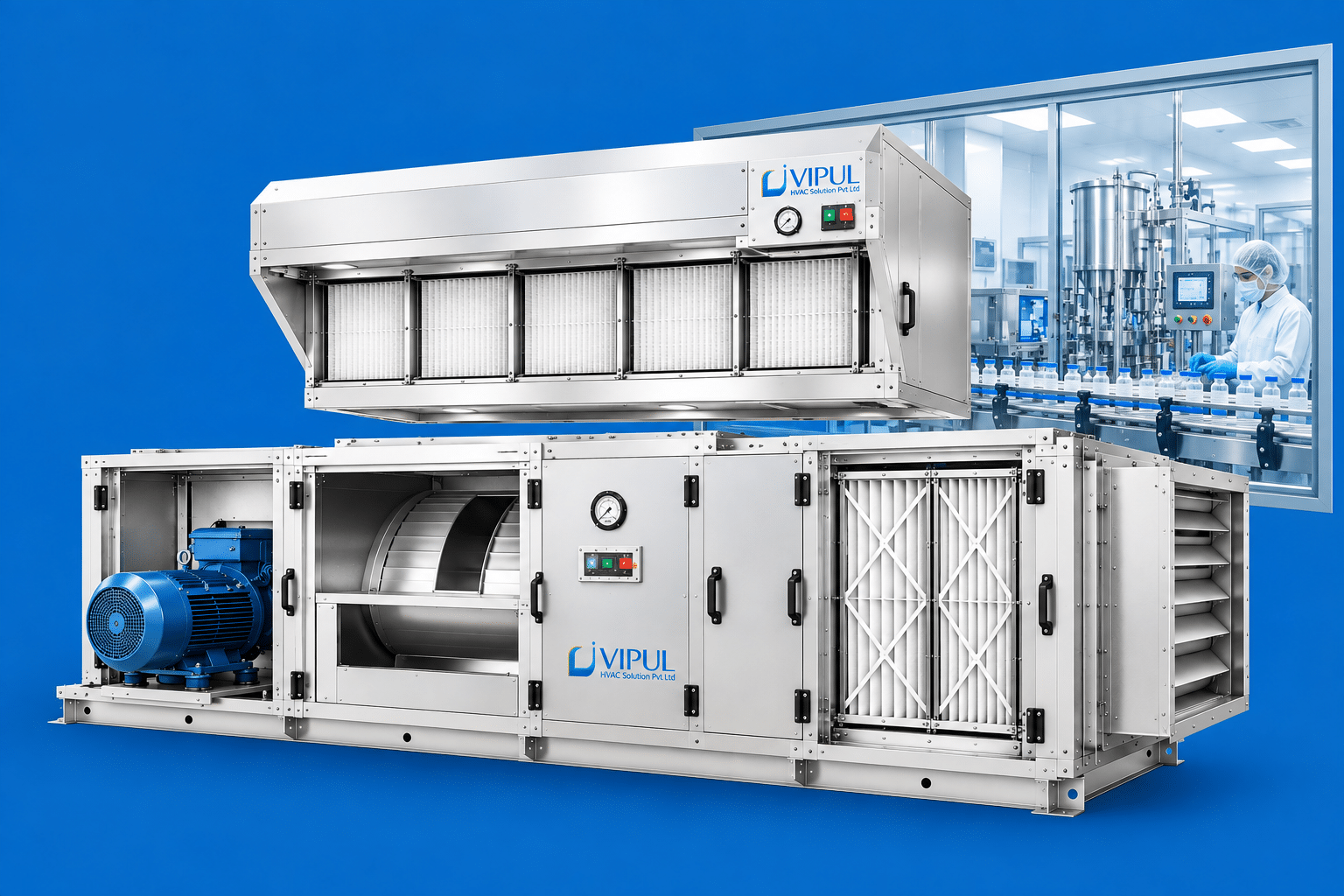
AHU for Pharmaceutical Industry: HVAC Design, GMP & Cleanroom Applications
The pharmaceutical industry requires carefully designed HVAC systems to support controlled environmental conditions, product quality, personnel comfort, and contamination-control strategies. Unlike conventional commercial HVAC systems, pharmaceutical HVAC systems must be designed according to the specific requirements of manufacturing areas, cleanrooms, laboratories, storage areas, packaging areas, and other controlled environments.
Vipul HVAC Solution Pvt Ltd provides HVAC engineering, AHU solutions, cleanroom HVAC, HEPA filtration, ducting, installation, testing, commissioning and maintenance support for pharmaceutical and other controlled-environment applications.
For pharmaceutical HVAC and AHU requirements, contact +91 8000392000.
What Is an AHU for the Pharmaceutical Industry?
A pharmaceutical AHU is an engineered air-handling system designed to condition and distribute air to controlled manufacturing and cleanroom environments.
Depending on the application, an AHU may incorporate:
- Fresh-air section
- Return-air section
- Mixing section where applicable
- Pre-filters
- Fine filters
- Cooling coil
- Heating or reheat arrangement
- Dehumidification
- Humidification where required
- Supply fan
- Variable-frequency drive (VFD)
- HEPA filtration
- Airflow control
- Differential-pressure monitoring
- Temperature and humidity sensors
- Control dampers
- Access doors
- Condensate management
- BMS integration
The exact configuration depends on the cleanroom classification, manufacturing process, product requirements, building design and applicable GMP and engineering requirements.
Pharmaceutical HVAC Design Requirements
Pharmaceutical HVAC design requires an integrated approach. The HVAC system should be designed around the process and environmental requirements rather than selecting an AHU based only on cooling capacity.
Important design parameters can include:
1. Temperature Control
Temperature should be controlled according to the requirements of the particular manufacturing, storage, laboratory or cleanroom application.
Stable temperature control can be important for:
- Product processes
- Material storage
- Personnel comfort
- Equipment operation
- Environmental control
2. Relative Humidity Control
Humidity control is an important consideration in pharmaceutical facilities.
Depending on the process, humidity can influence:
- Raw materials
- Powders
- Tablets
- Capsules
- Packaging materials
- Product stability
- Electrostatic conditions
- Personnel comfort
Pharmaceutical AHU systems can incorporate cooling, dehumidification, heating, reheat or humidification strategies where required.
3. Air Changes
Cleanroom airflow requirements depend on the room classification, process, occupancy, equipment and applicable design criteria.
There is no single air-change rate suitable for every pharmaceutical cleanroom.
The HVAC designer should determine the required airflow based on:
- Room classification
- Room volume
- Process requirements
- Occupancy
- Heat load
- Contamination-control strategy
- Pressure cascade
- Applicable standards and project specifications
GMP HVAC System for Pharmaceutical Facilities
GMP (Good Manufacturing Practice) provides a framework for controlling manufacturing and quality-related processes.
HVAC is an important part of the facility’s environmental-control strategy.
A GMP-oriented HVAC design may address:
- Temperature
- Relative humidity
- Air cleanliness
- Filtration
- Airflow direction
- Pressure differentials
- Cross-contamination control
- Fresh-air requirements
- Exhaust systems
- Cleaning and maintenance access
- Monitoring
- Documentation
- Testing and qualification requirements
The HVAC system should be designed in coordination with the pharmaceutical process, quality team, validation requirements and applicable regulatory/technical standards.
Cleanroom HVAC System
A pharmaceutical cleanroom HVAC system is designed to maintain controlled environmental conditions within a defined space.
The system may include:
Fresh Air → Pre-Filtration → Fine Filtration → Cooling/Dehumidification → Fan → HEPA Filtration → Cleanroom → Return/Exhaust
The exact arrangement varies depending on the application.
Cleanroom HVAC design can include:
- AHUs
- HEPA filters
- Terminal HEPA filtration
- Supply-air systems
- Return-air systems
- Exhaust systems
- Pressure-control systems
- Temperature controls
- Humidity controls
- Differential-pressure monitoring
- BMS
- Airflow balancing
HEPA Filtration in Pharmaceutical AHUs
HEPA filtration is commonly used in applications where high-efficiency particulate filtration is required.
HEPA filters may be installed within AHUs or at terminal locations depending on the HVAC design.
Important considerations include:
- Filter efficiency
- Airflow rate
- Filter face velocity
- Pressure drop
- Filter housing
- Sealing and gasket integrity
- Access for maintenance
- Differential-pressure monitoring
- Integrity testing where required
- Replacement procedure
The selection and location of HEPA filters should be based on the cleanroom and process requirements.
Pressure Differential in Pharmaceutical Cleanrooms
Pressure relationships are an important part of contamination-control strategies.
A pharmaceutical facility may use different pressure levels between adjacent rooms to control the direction of airflow.
For example, depending on the process, the HVAC system may be designed to maintain:
- Positive pressure
- Negative pressure
- Pressure cascade
- Controlled pressure differential
The appropriate pressure strategy depends on the product, process and contamination-control requirements.
Cross-Contamination Control
Pharmaceutical manufacturing may involve different products and materials. HVAC design therefore needs to consider the possibility of cross-contamination.
Design considerations may include:
- Airflow direction
- Dedicated AHUs
- Separate ventilation systems
- Pressure cascades
- Airlocks
- Material/personnel flow
- Appropriate exhaust systems
- Filtration
- Return-air strategy
- Room segregation
The final strategy should be determined from the facility’s contamination-control assessment and process requirements.
AHU for Pharmaceutical Cleanrooms
Different pharmaceutical areas can require different AHU configurations.
Manufacturing Cleanrooms
Manufacturing areas may require controlled:
- Temperature
- Humidity
- Air cleanliness
- Airflow
- Pressure
Packaging Areas
Packaging HVAC requirements depend on the materials, process, equipment and environmental conditions required.
Sampling Rooms
Sampling areas may require controlled airflow and contamination-control measures depending on the material being handled.
Dispensing Areas
Dispensing areas can require specialized airflow and pressure strategies depending on the product and material.
Laboratories
Laboratory HVAC may require dedicated supply, return and exhaust arrangements based on the laboratory processes.
Storage Areas
Pharmaceutical storage HVAC requirements depend on the stored materials and specified environmental conditions.
Pharmaceutical HVAC Duct Design
Ductwork is a major component of a pharmaceutical HVAC system.
Proper duct design should consider:
- Air velocity
- Static pressure
- Pressure losses
- Leakage
- Insulation
- Cleanability
- Access
- Air balancing
- Material selection
- Fire and smoke requirements
- Supply-air distribution
- Return-air arrangement
- Exhaust requirements
For controlled environments, duct construction and installation should be coordinated with the overall cleanroom and contamination-control strategy.
Pharmaceutical AHU Construction
Depending on the application, pharmaceutical AHUs may require features designed for controlled environments and ease of maintenance.
Possible considerations include:
- Double-skin construction
- Smooth internal surfaces
- Appropriate insulation
- Thermal-break construction where required
- Corrosion-resistant materials where appropriate
- Proper drain-pan design
- Sloped drain arrangements
- Access doors
- Inspection sections
- Filter sections
- Low-leakage construction
- Suitable fan arrangement
The final construction specification should be based on the project requirements.
Pharmaceutical HVAC Controls & BMS
Automation and monitoring can help maintain controlled environmental conditions.
A pharmaceutical HVAC control system may monitor:
- Supply-air temperature
- Return-air temperature
- Room temperature
- Relative humidity
- Differential pressure
- Filter differential pressure
- Fan status
- VFD speed
- Damper position
- Valve position
- AHU status
- Alarm conditions
Integration with a Building Management System (BMS) can provide centralized monitoring where specified.
Testing, Balancing & Commissioning
Testing and commissioning are essential stages of a pharmaceutical HVAC project.
Depending on the project requirements, activities may include:
- AHU performance testing
- Airflow measurement
- Supply-air balancing
- Return-air balancing
- Exhaust-air measurement
- Room pressure verification
- Temperature verification
- Humidity verification
- Filter differential-pressure checks
- HEPA filter integrity testing where required
- Airflow visualization where specified
- Control-system verification
Qualification and validation activities should be performed according to the approved project protocol and applicable requirements.
Pharmaceutical HVAC Maintenance
Regular preventive maintenance helps maintain HVAC performance.
Maintenance activities may include:
- AHU inspection
- Pre-filter replacement
- Fine-filter replacement
- HEPA filter inspection/testing
- Cooling-coil cleaning
- Condensate-drain inspection
- Fan and motor inspection
- Belt inspection where applicable
- Bearing inspection
- Damper inspection
- Sensor calibration
- Differential-pressure monitoring
- Duct inspection
- Control-system checks
Maintenance frequency should be determined according to equipment, operating conditions and the pharmaceutical facility’s maintenance program.
Why Choose Vipul HVAC Solution Pvt Ltd?
Vipul HVAC Solution Pvt Ltd provides HVAC solutions for pharmaceutical, industrial, commercial and specialized facilities.
Our pharmaceutical HVAC approach focuses on designing the complete system around the environmental and process requirements of the facility.
Our Pharmaceutical HVAC Capabilities
- Pharmaceutical AHU systems
- Pharma HVAC design
- GMP HVAC systems
- Cleanroom HVAC
- Cleanroom AHU
- HEPA filtration systems
- Temperature control
- Humidity control
- Pressure-control systems
- Fresh-air ventilation
- Pharmaceutical ducting
- AHU installation
- HVAC controls
- BMS integration
- Air balancing
- Testing and commissioning
- HVAC maintenance and AMC
Our Pharmaceutical HVAC Project Approach
1. Site & Requirement Assessment
We evaluate the facility layout, process requirements, room functions and environmental conditions.
2. HVAC Load Calculation
Cooling, heating and ventilation requirements are evaluated according to the project design criteria.
3. Airflow Design
Supply, return, fresh-air and exhaust requirements are established for individual areas.
4. Filtration Design
Appropriate filtration stages are selected based on the environmental and cleanroom requirements.
5. AHU Selection
AHU airflow, cooling capacity, static pressure, filtration and fan requirements are evaluated.
6. Duct Design
Supply, return, fresh-air and exhaust ductwork is designed around the required airflow distribution.
7. Installation
AHUs, ducting, piping, controls and associated HVAC systems are installed according to the approved project design.
8. Testing & Commissioning
The installed HVAC system is tested, balanced and commissioned according to project requirements.
Benefits of a Proper Pharmaceutical AHU System
A properly engineered pharmaceutical HVAC system can help provide:
- Controlled environmental conditions
- Consistent temperature
- Controlled humidity
- Effective particulate filtration
- Appropriate airflow distribution
- Controlled pressure relationships
- Improved contamination-control strategy
- Better equipment protection
- Reliable HVAC operation
- Easier monitoring and maintenance
The actual performance depends on correct design, installation, operation, maintenance and qualification.
Company & Model Details
Treated Fresh Air Handling Unit
- AHU Selection & Customization
- Duct & Air Distribution Design
- Filtration & IAQ Planning
- Installation & Commissioning
- Maintenance Planning
- 2-Stage Unit
- Air Washer
What is an AHU in the pharmaceutical industry?
An AHU is an Air Handling Unit used to condition and distribute air in pharmaceutical manufacturing areas, cleanrooms, laboratories, storage areas and other controlled environments.
What is GMP HVAC?
GMP HVAC refers to HVAC systems designed and operated to support the environmental and contamination-control requirements associated with Good Manufacturing Practice.
Is HEPA filtration required in every pharmaceutical AHU?
No. HEPA requirements depend on the cleanroom classification, process, product, contamination-control strategy and applicable project requirements.
What is the purpose of HEPA filters in pharmaceutical cleanrooms?
HEPA filters provide high-efficiency particulate filtration and are used where the cleanroom or process requires this level of air filtration.
What is a cleanroom AHU?
A cleanroom AHU is an air-handling system designed to provide controlled airflow, temperature, humidity and filtration for a cleanroom environment.
Why is humidity control important in pharmaceutical HVAC?
Humidity can affect certain pharmaceutical materials, products, processes, packaging materials and personnel comfort. The required humidity range depends on the specific application.
What is pressure cascade in a pharmaceutical facility?
A pressure cascade is a planned difference in pressure between adjacent rooms that helps control the direction of airflow and supports the facility’s contamination-control strategy.
What is the difference between a normal AHU and a pharmaceutical AHU?
A pharmaceutical AHU may require additional attention to filtration, humidity, pressure control, construction, cleanability, monitoring and documentation compared with conventional commercial HVAC equipment.
Can Vipul HVAC Solution design cleanroom HVAC systems?
Vipul HVAC Solution Pvt Ltd provides HVAC engineering and solutions for cleanroom and pharmaceutical applications, including AHUs, filtration, ducting, controls, installation and commissioning.
Does pharmaceutical HVAC require HEPA filter testing?
Where HEPA filters are specified, appropriate testing and verification should be performed according to the project requirements and applicable standards.
Can HVAC systems be integrated with BMS?
Yes. Pharmaceutical HVAC systems can be designed for BMS integration to monitor and control parameters such as temperature, humidity, pressure, AHU status and alarms.
How can I contact Vipul HVAC Solution Pvt Ltd?
For pharmaceutical AHU, GMP HVAC and cleanroom HVAC requirements, contact Vipul HVAC Solution Pvt Ltd at +91 8000392000.