
- Home
- About Us
-
Products
- Split Ac & Cassette Ac & Floor Stand Ac
- Ducted & Package Air Conditioning
- Vrf / Vrv Systems
- Ventilation Systems
- Fan Coil Units (Fcu)
- Haima Industrial Panel AC
- Air Handling Units (Ahu)
- Heat Pump System
- Bms & Hvac Automation
- Duct Work System
- Precision Air Conditioning (Pac)
- Chiller Systems
- Kitchen Exhaust & Smoke Management Systems
- Flame Proof Ac / Explosion Proof Ac
- Services
- Blogs
- Contact Us
AHU for Hotels
Home >AHU for Hotels
A properly designed AHU for hotels can provide centralized air conditioning, fresh-air ventilation, filtration, temperature control and humidity management according to the requirements of each hotel area.
All Products
need any help ?
24/7 direct call
+91 800-0392-000
info@vipulhvacsolution.in
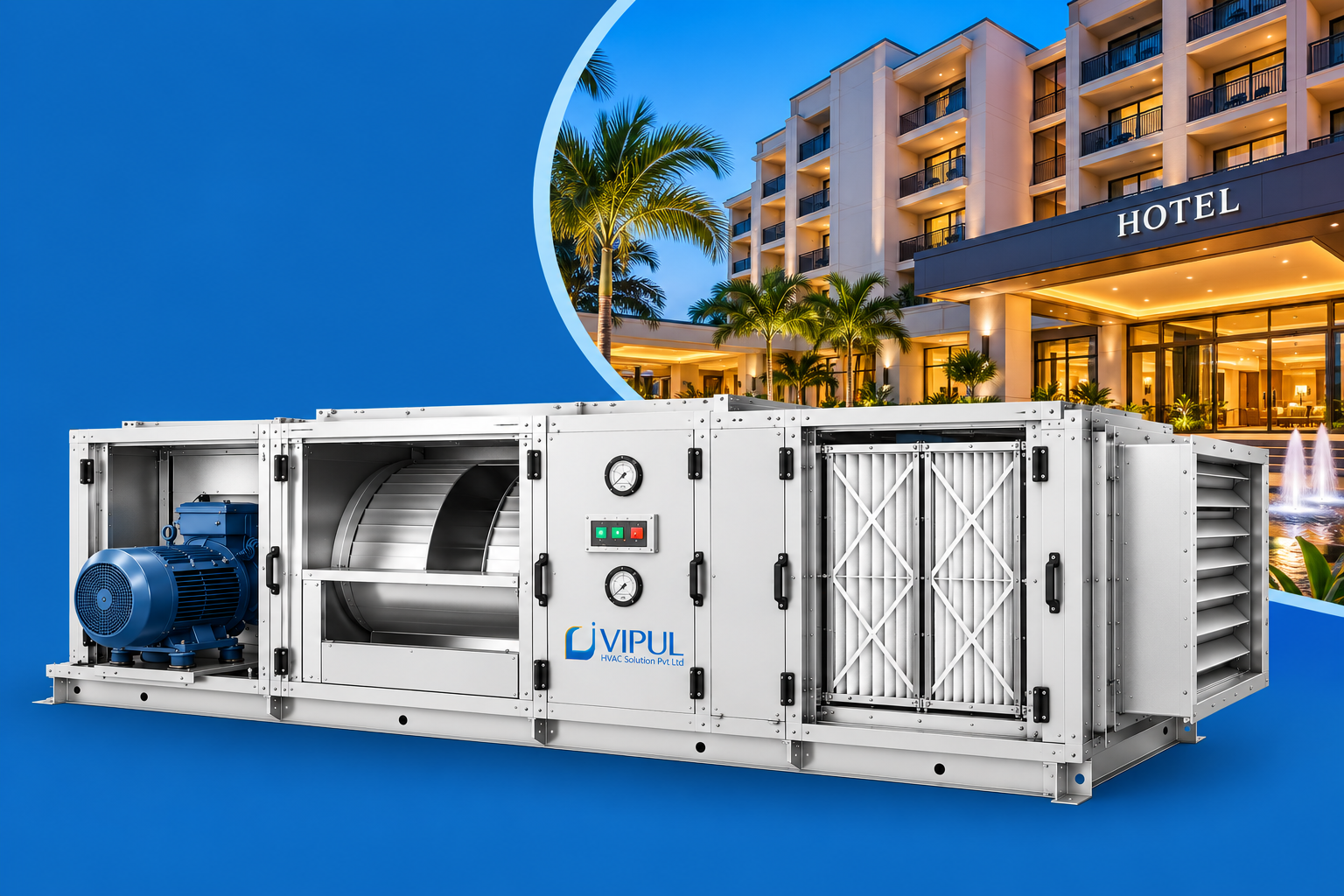
AHU for Hotels: Centralized HVAC Design, Fresh Air & Comfort Control
Hotels require reliable HVAC systems to maintain comfortable indoor conditions for guests, staff and visitors across bedrooms, restaurants, lobbies, banquet halls, kitchens, corridors, conference rooms and other areas.
Unlike a simple residential air-conditioning system, hotel HVAC design needs to consider different occupancy levels, operating schedules, fresh-air requirements, heat loads, indoor air quality, energy consumption and guest comfort.
Vipul HVAC Solution Pvt Ltd provides hotel HVAC solutions including AHU selection, centralized HVAC design, fresh-air ventilation, ducting, installation, controls, testing, commissioning and maintenance.
For hotel AHU and HVAC solutions, call +91 8000392000.
Company & Model Details
Treated Fresh Air Handling Unit
- AHU Selection & Customization
- Duct & Air Distribution Design
- Filtration & IAQ Planning
- Installation & Commissioning
- Maintenance Planning
- 2-Stage Unit
- Air Washer
What Is an AHU for Hotels?
An Air Handling Unit (AHU) is a major component of a centralized HVAC system that conditions and distributes air throughout different areas of a hotel.
Depending on the project requirements, a hotel AHU can include:
- Fresh-air intake section
- Return-air section
- Mixing section
- Pre-filtration
- Fine filtration
- Cooling coil
- Heating or reheat arrangement
- Supply fan
- VFD
- Humidity-control provisions
- Motor and drive system
- Control dampers
- Temperature sensors
- Differential-pressure monitoring
- BMS integration
- Condensate drainage system
- Access and maintenance sections
The AHU configuration should be selected according to the hotel’s size, room layout, occupancy, operating schedule, climate, building design and HVAC requirements.
Why Is HVAC Important for Hotels?
Guest comfort is an important consideration in hotel HVAC design.
A hotel’s HVAC system must handle changing loads caused by:
- Guest occupancy
- Outdoor weather
- Solar heat gain
- Lighting
- Electrical equipment
- Kitchen equipment
- Banquet events
- Restaurant operations
- Conference rooms
- Lobby traffic
- Doors opening and closing
- Fresh-air requirements
The HVAC system should therefore be designed to provide stable and comfortable conditions despite changing building loads.
Centralized HVAC Design for Hotels
A centralized HVAC system can provide conditioned air to different areas of a hotel through AHUs, ductwork and associated equipment.
A typical centralized arrangement can include:
Chiller/VRF/Other Cooling Source → AHU → Ductwork → Air Terminals → Hotel Spaces → Return Air → AHU
The exact system architecture depends on the hotel building and project requirements.
A hotel may use different HVAC systems for different zones, such as:
- Guest rooms
- Lobby
- Restaurants
- Banquet halls
- Kitchen
- Conference rooms
- Corridors
- Back-of-house areas
- Offices
- Service areas
Hotel AHU Design Requirements
Hotel AHU design should consider several important parameters.
1. Cooling Load Calculation
Cooling capacity should be determined through proper HVAC load calculations.
Factors can include:
- Building orientation
- Outdoor temperature
- Solar heat gain
- Wall and roof construction
- Glass area
- Occupancy
- Lighting
- Equipment
- Fresh air
- Operating schedules
Correct load calculation helps avoid both undersizing and unnecessary oversizing.
2. Fresh Air Requirements
Fresh-air ventilation is an important component of hotel HVAC.
Hotels have varying occupancy levels, particularly in:
- Guest rooms
- Restaurants
- Banquet halls
- Conference rooms
- Lobbies
- Fitness areas
Fresh-air requirements should be calculated according to the room function, occupancy and applicable ventilation standards.
3. Indoor Air Quality
A hotel HVAC system should support good indoor environmental quality.
Important considerations include:
- Outdoor air
- Filtration
- Ventilation
- Temperature
- Humidity
- Air distribution
- Exhaust systems
Fresh-air and exhaust systems should be properly balanced to maintain the intended indoor conditions.
Fresh Air System for Hotels
Fresh air is required to introduce outdoor air into occupied spaces and remove or dilute indoor contaminants.
A hotel fresh-air system may include:
- Fresh-air AHU
- Fresh-air fans
- Fresh-air ducts
- Motorized dampers
- Filters
- Heat recovery where appropriate
- CO₂ monitoring where specified
- Exhaust systems
- BMS controls
Fresh-air design should consider the occupancy and function of each space.
AHU for Hotel Guest Rooms
Guest rooms require individual comfort control and suitable ventilation.
Depending on the hotel design, guest-room HVAC may use:
- FCU
- VRF
- Ducted units
- Central AHU systems
- Fresh-air systems
Where centralized AHUs are used, the design should address:
- Guest comfort
- Noise
- Fresh air
- Temperature control
- Air distribution
- Individual zoning where required
The appropriate solution depends on the hotel architecture and operational model.
AHU for Hotel Lobby
Hotel lobbies can experience significant variations in occupancy.
The HVAC system should consider:
- Large entrance doors
- Outdoor air infiltration
- High occupancy
- Solar heat gain
- Reception equipment
- Lighting
- Guest movement
A properly sized AHU can help maintain stable temperature and ventilation conditions.
AHU for Hotel Banquet Halls
Banquet halls can have highly variable occupancy.
A hall may be nearly empty during one period and heavily occupied during an event.
Therefore, the HVAC design should consider:
- Variable occupancy
- High fresh-air requirements
- Lighting loads
- Sound levels
- Temperature control
- Air distribution
- Variable-speed operation
VFDs and suitable control strategies can help match HVAC operation to changing loads.
AHU for Hotel Restaurants
Restaurant HVAC requires careful coordination because of occupancy, kitchen exhaust and food-service activities.
The HVAC design should consider:
- Dining-area ventilation
- Fresh-air supply
- Kitchen exhaust
- Make-up air
- Odor control
- Temperature
- Pressure relationships
- Filtration
Kitchen exhaust systems should be designed separately according to the kitchen equipment and applicable requirements.
AHU for Hotel Kitchens
Hotel kitchens generate significant heat, moisture and contaminants.
A kitchen HVAC system may include:
- Kitchen exhaust
- Fresh/make-up air
- Supply-air system
- Exhaust fans
- Hoods
- Grease filtration
- Ventilation controls
The kitchen exhaust and make-up-air system should be coordinated with the overall hotel HVAC design.
Hotel HVAC for Conference Rooms
Conference rooms can experience rapid changes in occupancy.
The HVAC system should consider:
- Occupancy
- Fresh-air requirement
- CO₂ levels
- Equipment heat loads
- Lighting
- Temperature control
Demand-based ventilation may be considered where appropriate to adjust outdoor airflow based on occupancy or indoor-air-quality indicators.
Hotel HVAC Filtration
Filtration helps reduce airborne particulate matter entering occupied areas.
Hotel AHUs may use multiple filtration stages depending on the project’s requirements.
A typical arrangement can include:
Fresh Air → Pre-Filter → Fine Filter → Cooling Coil → Fan → Supply Air
The filtration system should be selected based on:
- Outdoor air quality
- AHU airflow
- Filter efficiency
- Pressure drop
- Maintenance requirements
- Indoor-air-quality objectives
Hotel HVAC Temperature & Humidity Control
Temperature and humidity influence guest comfort and building operation.
A hotel HVAC system may incorporate:
- Cooling coils
- Heating systems where required
- Reheat
- Dehumidification
- Humidification where necessary
- Temperature sensors
- Humidity sensors
- Automatic controls
Different hotel areas may have different environmental requirements.
Hotel HVAC Duct Design
Ductwork distributes conditioned air from AHUs to occupied spaces.
Hotel duct design should consider:
- Airflow
- Air velocity
- Static pressure
- Pressure losses
- Noise
- Insulation
- Leakage
- Fire and smoke requirements
- Access
- Air balancing
Special attention should be given to acoustics because excessive HVAC noise can negatively affect guest comfort.
Noise Control in Hotel HVAC
Noise control is particularly important in hotels.
HVAC design can consider:
- Fan selection
- Fan speed
- Duct velocity
- Acoustic lining where appropriate
- Flexible connections
- Vibration isolation
- Equipment location
- Air-terminal selection
AHUs and other mechanical equipment should be located and isolated appropriately to minimize unwanted noise and vibration.
Hotel HVAC Controls & BMS
A Building Management System (BMS) can provide centralized monitoring and control of hotel HVAC equipment.
The system can monitor:
- AHU status
- Supply-air temperature
- Return-air temperature
- Room temperature
- Relative humidity
- Fan status
- VFD speed
- Filter differential pressure
- Valve position
- Damper position
- Alarm conditions
- Energy-related parameters where supported
BMS integration can help hotel operators monitor HVAC systems across multiple areas.
Energy-Efficient Hotel HVAC Design
Hotels often operate HVAC systems for long periods, making energy efficiency an important design consideration.
Possible energy-saving strategies include:
- High-efficiency AHUs
- Efficient fans
- VFDs
- Variable-air-volume systems where suitable
- Demand-based ventilation
- Heat recovery where appropriate
- BMS controls
- Efficient chillers or VRF systems
- Proper insulation
- Optimized operating schedules
- Preventive maintenance
Energy-saving measures should be evaluated according to the hotel’s building design and operational requirements.
Hotel HVAC Testing & Commissioning
After installation, the HVAC system should be tested and commissioned.
Depending on project requirements, commissioning may include:
- AHU performance checks
- Airflow measurement
- Air balancing
- Fresh-air measurement
- Exhaust-air measurement
- Temperature verification
- Humidity verification
- Pressure checks
- Fan performance checks
- Control-system testing
- BMS verification
Proper balancing is important to ensure that different hotel areas receive the designed airflow.
Hotel HVAC Maintenance
Regular maintenance helps maintain HVAC performance and guest comfort.
Maintenance activities can include:
- AHU inspection
- Filter cleaning/replacement
- Cooling-coil cleaning
- Condensate-drain cleaning
- Fan inspection
- Motor inspection
- Belt inspection
- Bearing inspection
- Damper inspection
- Sensor calibration
- VFD inspection
- Duct inspection
- BMS checks
A preventive-maintenance program should be established according to equipment and operating conditions.
Why Choose Vipul HVAC Solution Pvt Ltd?
Vipul HVAC Solution Pvt Ltd provides HVAC engineering and contracting solutions for hotels, commercial buildings, industrial facilities and other applications.
Our Hotel HVAC Capabilities
- Hotel AHU systems
- Centralized HVAC design
- Hotel fresh-air systems
- Hotel ventilation
- HVAC load calculation
- AHU selection
- Chiller-based HVAC systems
- VRF/VRV solutions
- Hotel ducting
- Kitchen ventilation
- Kitchen exhaust systems
- BMS integration
- HVAC controls
- Air balancing
- Testing and commissioning
- HVAC maintenance and AMC
Integrated Design Approach
We evaluate the relationship between:
Cooling Load + AHU + Fresh Air + Filtration + Ductwork + Air Distribution + Controls + BMS
This helps create an HVAC solution aligned with the functional requirements of each hotel area.
Our Hotel HVAC Project Process
1. Site Assessment
We evaluate the hotel layout, building characteristics and HVAC requirements.
2. Load Calculation
Cooling and ventilation loads are calculated based on the project parameters.
3. Zoning
Hotel spaces are divided into suitable HVAC zones based on usage and operating schedules.
4. AHU Selection
AHU airflow, cooling capacity, static pressure and filtration requirements are evaluated.
5. Fresh-Air Design
Fresh-air and exhaust requirements are calculated according to room function and occupancy.
6. Duct Design
Supply, return, fresh-air and exhaust ductwork is designed.
7. Installation
AHUs, ducts, piping, controls and associated HVAC equipment are installed.
8. Testing & Commissioning
The system is tested, balanced and commissioned according to the approved project requirements.
Benefits of a Properly Designed Hotel AHU System
A properly designed hotel HVAC system can help provide:
- Better guest comfort
- Stable temperature
- Appropriate fresh-air ventilation
- Improved indoor-air quality
- Effective air distribution
- Better humidity control
- Reduced HVAC noise
- Efficient equipment operation
- Centralized monitoring
- Easier maintenance
Actual performance depends on proper design, equipment selection, installation, balancing, operation and maintenance.
What is an AHU in a hotel?
An AHU is an Air Handling Unit used to condition and distribute air to different hotel areas. It can provide cooling, filtration, ventilation and humidity control depending on the system design.
Why is fresh air important in hotels?
Fresh air helps provide ventilation for occupied spaces and can help dilute indoor contaminants. The required amount depends on occupancy, room function and applicable ventilation requirements.
Which HVAC system is suitable for hotels?
Hotels can use different systems, including AHU-based centralized HVAC, chilled-water systems, VRF/VRV, FCUs and combinations of these systems. The appropriate solution depends on the building and operational requirements.
Can AHUs be used for hotel guest rooms?
Yes. AHUs can serve guest-room zones, although hotels may also use FCUs, VRF or other systems for individual room comfort control.
What is a fresh-air AHU?
A fresh-air AHU is designed to introduce and condition outdoor air before supplying it to the building or designated zones.
How do you select an AHU for a hotel?
AHU selection considers cooling load, airflow, fresh-air requirement, static pressure, filtration, occupancy, zoning, operating schedule and space requirements.
Is filtration required in hotel AHUs?
Yes, appropriate filtration is normally part of AHU design. The filtration level depends on outdoor air quality, indoor-air-quality requirements and the project specifications.
How can hotel HVAC energy consumption be reduced?
Strategies can include efficient fans, VFDs, appropriate zoning, BMS controls, demand-based ventilation, heat recovery where suitable, efficient cooling equipment and preventive maintenance.
Does Vipul HVAC Solution provide hotel AHU installation?
Yes. Vipul HVAC Solution Pvt Ltd provides hotel HVAC services including AHU selection, installation, ducting, controls, testing, commissioning and maintenance.
Can hotel HVAC systems be integrated with BMS?
Yes. Hotel HVAC systems can be integrated with BMS for centralized monitoring and control of AHUs, temperatures, fans, dampers, valves and alarms.
Does Vipul HVAC Solution provide hotel HVAC maintenance?
Yes. HVAC maintenance and AMC services can include AHU inspection, filter maintenance, coil cleaning, fan and motor checks, controls and other preventive-maintenance activities.
How can I contact Vipul HVAC Solution Pvt Ltd?
For hotel AHU, centralized HVAC, fresh-air ventilation and comfort-control solutions, contact Vipul HVAC Solution Pvt Ltd at +91 8000392000.