
- Home
- About Us
-
Products
- Split Ac & Cassette Ac & Floor Stand Ac
- Ducted & Package Air Conditioning
- Vrf / Vrv Systems
- Ventilation Systems
- Fan Coil Units (Fcu)
- Haima Industrial Panel AC
- Air Handling Units (Ahu)
- Heat Pump System
- Bms & Hvac Automation
- Duct Work System
- Precision Air Conditioning (Pac)
- Chiller Systems
- Kitchen Exhaust & Smoke Management Systems
- Flame Proof Ac / Explosion Proof Ac
- Services
- Blogs
- Contact Us
AHU for Manufacturing Plants
Home >AHU for Manufacturing Plants
An AHU for manufacturing plants is an important part of an industrial HVAC system. It can provide conditioned and filtered air while supporting temperature control, fresh-air ventilation, humidity management, air distribution and exhaust-air requirements.
All Products
For manufacturing plant AHU and industrial HVAC solutions?
Comfort is Just a Click Away!
need any help ?
24/7 direct call
+91 800-0392-000
info@vipulhvacsolution.in
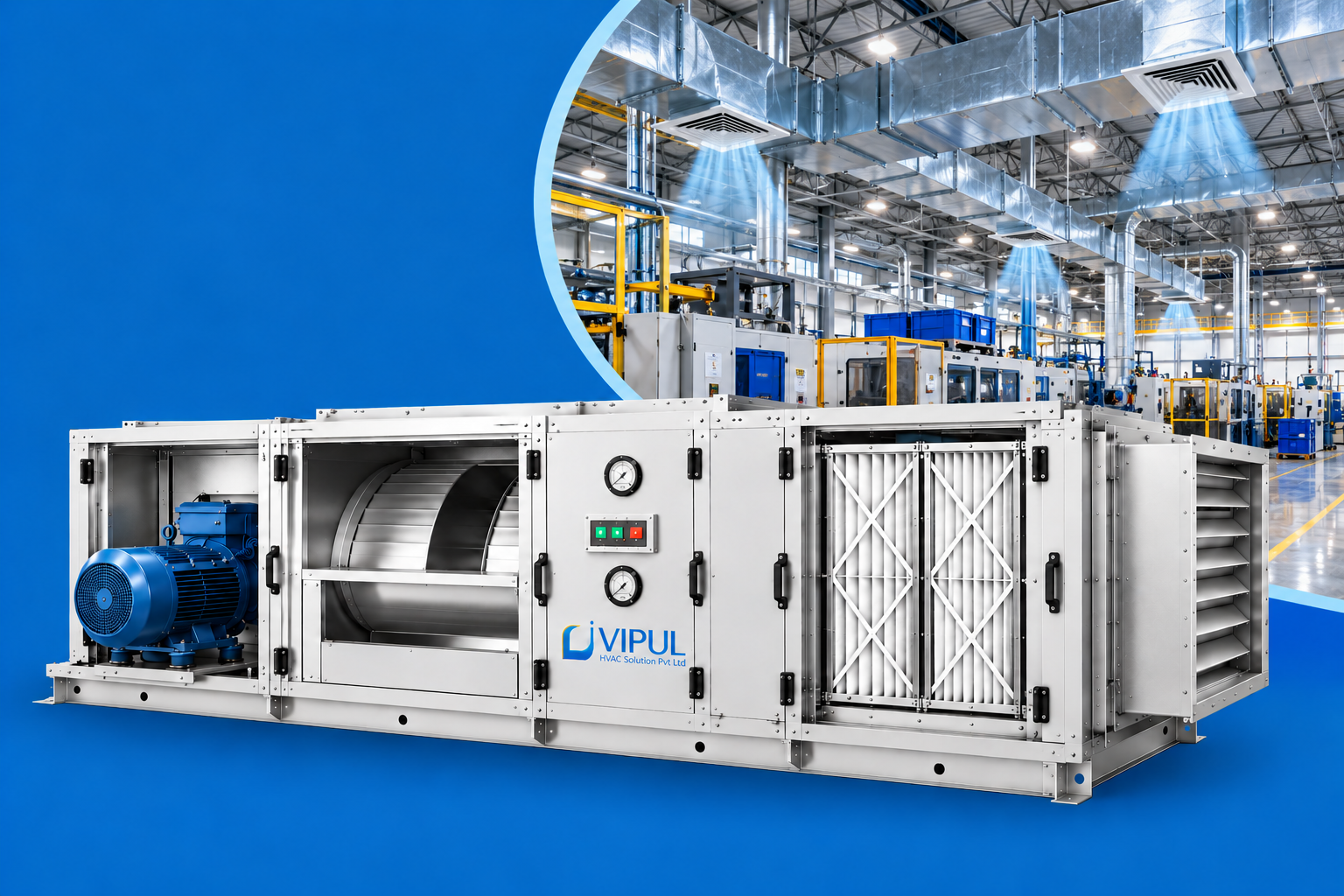
AHU for Manufacturing Plants: Industrial Ventilation & Air Conditioning
Manufacturing plants require HVAC systems designed around production processes, equipment heat loads, worker comfort, ventilation requirements and the specific environmental conditions of the facility.
Industrial HVAC design differs from conventional commercial HVAC because manufacturing areas may generate significant heat, dust, fumes, moisture, odors or other airborne contaminants.
Vipul HVAC Solution Pvt Ltd provides industrial AHU and HVAC solutions for manufacturing plants, factories, warehouses and process facilities, including HVAC design, ventilation, AHU selection, ducting, installation, controls, testing, commissioning and maintenance.
For manufacturing plant AHU and industrial HVAC solutions, call +91 8000392000.
Company & Model Details
Treated Fresh Air Handling Unit
- AHU Selection & Customization
- Duct & Air Distribution Design
- Filtration & IAQ Planning
- Installation & Commissioning
- Maintenance Planning
- 2-Stage Unit
- Air Washer
What Is an AHU for Manufacturing Plants?
An Air Handling Unit (AHU) is HVAC equipment used to condition and distribute air within manufacturing and industrial facilities.
Depending on the application, an industrial AHU can include:
- Fresh-air intake section
- Return-air section
- Mixing section
- Pre-filters
- Fine filters
- Cooling coil
- Heating coil where required
- Dehumidification
- Humidification where required
- Supply fan
- VFD
- Control dampers
- Temperature sensors
- Humidity sensors
- Differential-pressure monitoring
- BMS integration
- Condensate drainage
- Access and maintenance sections
The AHU configuration should be selected according to the manufacturing process, heat load, ventilation requirements, building layout and environmental conditions.
Why Is HVAC Important for Manufacturing Plants?
Manufacturing processes can produce substantial internal heat and airborne contaminants.
Industrial facilities may have heat sources such as:
- Production machinery
- Motors
- Furnaces
- Compressors
- Electrical equipment
- Lighting
- Welding equipment
- Process equipment
- Personnel
- Solar heat gain
Depending on the manufacturing process, the facility may also generate:
- Dust
- Fumes
- Smoke
- Vapors
- Odors
- Moisture
- Process contaminants
The HVAC and ventilation system should therefore be designed around the actual manufacturing process.
Industrial HVAC Design for Manufacturing Plants
Industrial HVAC design should start with an understanding of the production process.
Important design considerations include:
- Cooling load
- Heating load
- Process heat
- Fresh-air requirements
- Exhaust requirements
- Air changes
- Temperature
- Humidity
- Filtration
- Air distribution
- Pressure relationships
- Indoor-air quality
- Worker comfort
- Equipment operating conditions
A suitable industrial HVAC strategy may combine AHUs, ventilation fans, exhaust systems, chillers, cooling towers, VRF/VRV systems, evaporative cooling or other technologies depending on the facility.
Manufacturing Plant AHU Design Requirements
1. Cooling Load Calculation
Industrial cooling loads can be substantially different from commercial buildings.
The calculation may consider:
- Machinery heat
- Production equipment
- Motors
- Lighting
- Workers
- Solar heat gain
- Outdoor air
- Process loads
- Building envelope
- Operating schedules
Accurate calculations help determine the required AHU airflow and cooling capacity.
2. Fresh Air & Ventilation
Fresh-air ventilation can help provide outdoor air to occupied areas and support the removal or dilution of indoor contaminants.
Fresh-air requirements depend on:
- Occupancy
- Manufacturing process
- Room size
- Outdoor conditions
- Contaminant generation
- Exhaust requirements
- Applicable ventilation criteria
Fresh-air systems should be coordinated with the building’s exhaust strategy.
Industrial Ventilation System
Industrial ventilation is an important part of manufacturing plant HVAC.
A ventilation system can include:
- Fresh-air fans
- Exhaust fans
- AHUs
- Supply-air ducts
- Exhaust ducts
- Louvers
- Filters
- Dust collectors
- Fume extraction systems
- Make-up air systems
- Dampers
- Control systems
The ventilation strategy should be based on the specific contaminants and process conditions present in the plant.
Local Exhaust Ventilation
Where a manufacturing process produces dust, fumes, vapors or other contaminants, local exhaust ventilation (LEV) may be appropriate.
LEV attempts to capture contaminants close to their source rather than allowing them to disperse throughout the production area.
Potential applications include:
- Welding areas
- Chemical processes
- Grinding
- Cutting
- Painting
- Mixing
- Heat-treatment processes
- Material handling
The exhaust system should be engineered according to the process and contaminant characteristics.
AHU for Factory Production Areas
Production areas can have different HVAC requirements depending on the process.
The HVAC system may be designed to control:
- Temperature
- Humidity
- Airflow
- Fresh air
- Filtration
- Heat removal
- Air distribution
Production areas with high heat loads may require higher airflow or dedicated cooling systems.
AHU for Industrial Warehouses
Warehouses may require HVAC depending on:
- Stored materials
- Product temperature requirements
- Worker occupancy
- Building height
- Heat gain
- Storage conditions
- Fresh-air requirements
The HVAC solution can include AHUs, ventilation fans, evaporative cooling, exhaust systems or other appropriate technologies.
AHU for Process Areas
Process areas may require tighter environmental control than general factory spaces.
Depending on the application, HVAC systems can provide:
- Controlled temperature
- Humidity control
- Filtration
- Fresh air
- Pressure control
- Dedicated exhaust
- Process ventilation
Pharmaceutical, electronics, food-processing and other specialized manufacturing facilities may require additional environmental controls.
Industrial Air Conditioning
Industrial air conditioning involves more than simply cooling the factory.
The system should consider:
- Sensible heat
- Latent heat
- Process heat
- Outdoor air
- Equipment loads
- Worker comfort
- Humidity
- Ventilation
- Air distribution
- Operating schedules
Possible cooling technologies include:
- Chilled-water AHUs
- Air-cooled chillers
- Water-cooled chillers
- VRF/VRV
- Packaged systems
- Evaporative cooling
- Dedicated process cooling
The appropriate technology depends on the plant and process requirements.
Temperature & Humidity Control
Certain manufacturing processes require controlled temperature and humidity.
Humidity can affect:
- Raw materials
- Production processes
- Product quality
- Packaging
- Electronics
- Powder handling
- Corrosion
- Static electricity
An industrial AHU can incorporate:
- Cooling coils
- Heating coils
- Reheat
- Dehumidification
- Humidification
- Temperature sensors
- Humidity sensors
- Automatic controls
Industrial HVAC Filtration
Filtration should be selected according to the contaminants and indoor-air-quality requirements of the manufacturing plant.
Potential filtration stages include:
Outdoor Air → Pre-Filter → Fine Filter → Cooling Coil → Fan → Supply Air
Additional filtration or specialized equipment may be required for specific industrial processes.
Possible solutions include:
- Bag filters
- Panel filters
- Fine filters
- HEPA filters where required
- Dust collectors
- Fume filtration
- Process-specific filtration
The correct filtration system depends on the contaminant and process.
Manufacturing Plant Air Distribution
Air distribution should be designed according to the building layout and process.
Important considerations include:
- Supply-air quantity
- Return-air quantity
- Air velocity
- Ceiling height
- Equipment location
- Worker areas
- Heat sources
- Exhaust locations
- Airflow pattern
Proper air distribution helps avoid stagnant areas and excessive temperature variations.
Industrial HVAC Duct Design
Industrial ductwork may need to handle large airflow volumes and higher operating pressures.
Design considerations include:
- Air velocity
- Static pressure
- Pressure losses
- Duct dimensions
- Material selection
- Insulation
- Leakage
- Support systems
- Access for cleaning
- Fire and smoke requirements
- Air balancing
Process-exhaust ductwork should be designed according to the characteristics of the exhaust stream.
Make-Up Air System
When large exhaust systems operate in a manufacturing facility, replacement air may be required.
A make-up air system can provide conditioned or filtered outdoor air to compensate for exhausted air.
Benefits can include:
- Better pressure control
- Improved ventilation
- Reduced uncontrolled infiltration
- Improved worker comfort
- Better exhaust-system performance
Make-up air requirements should be coordinated with the plant’s exhaust system.
Industrial HVAC Controls & BMS
A Building Management System (BMS) can provide centralized monitoring and control of industrial HVAC equipment.
Parameters may include:
- AHU status
- Supply-air temperature
- Return-air temperature
- Room temperature
- Relative humidity
- Fan status
- VFD speed
- Filter differential pressure
- Damper position
- Valve position
- Exhaust-fan status
- Alarm conditions
Process-specific controls can be incorporated where required.
Energy-Efficient HVAC for Manufacturing Plants
Industrial HVAC systems can consume substantial amounts of energy.
Potential energy-efficiency measures include:
VFD Fans
Variable Frequency Drives can adjust fan speed according to airflow requirements.
Efficient AHUs
Proper AHU and fan selection can help reduce unnecessary energy consumption.
Zoning
Separate HVAC zones can allow systems to operate according to actual requirements.
Heat Recovery
Heat-recovery systems can be considered for suitable fresh-air and exhaust applications.
BMS Controls
Automated scheduling and monitoring can help optimize HVAC operation.
Preventive Maintenance
Clean filters, coils and properly maintained fans can help maintain system performance.
Testing & Commissioning
Industrial HVAC systems should be tested and commissioned after installation.
Depending on project requirements, activities can include:
- AHU performance testing
- Airflow measurement
- Supply-air balancing
- Return-air balancing
- Fresh-air measurement
- Exhaust-air measurement
- Temperature verification
- Humidity verification
- Pressure checks
- Fan performance testing
- Control-system verification
- BMS testing
Proper commissioning helps verify that the installed system performs according to the approved design.
Industrial HVAC Maintenance
Preventive maintenance is important for reliable manufacturing plant operation.
Maintenance activities can include:
- AHU inspection
- Filter cleaning/replacement
- Cooling-coil cleaning
- Condensate-drain inspection
- Fan inspection
- Motor inspection
- Belt inspection
- Bearing inspection
- Damper inspection
- Sensor calibration
- VFD inspection
- Exhaust-fan inspection
- Duct inspection
- BMS checks
Maintenance schedules should be developed according to equipment, operating conditions and the manufacturing process.
Why Choose Vipul HVAC Solution Pvt Ltd?
Vipul HVAC Solution Pvt Ltd provides industrial HVAC engineering and contracting solutions for manufacturing plants, factories, warehouses and specialized industrial facilities.
Our Industrial HVAC Capabilities
- Manufacturing plant AHU systems
- Industrial HVAC design
- Industrial ventilation
- Factory air conditioning
- Fresh-air systems
- Process ventilation
- Exhaust systems
- Make-up air systems
- Dust and fume extraction solutions
- Chilled-water HVAC systems
- VRF/VRV solutions
- Industrial ducting
- AHU installation
- HVAC controls
- BMS integration
- Air balancing
- Testing and commissioning
- HVAC maintenance and AMC
Integrated Industrial HVAC Approach
We evaluate the complete system:
Process Load + Cooling Load + AHU + Fresh Air + Exhaust + Filtration + Ductwork + Air Distribution + Controls
This approach helps develop an HVAC and ventilation system based on the actual requirements of the manufacturing facility.
Our Manufacturing Plant HVAC Project Process
1. Site Assessment
We evaluate the plant layout, production process, equipment and existing HVAC infrastructure.
2. Process & Load Assessment
We identify heat-generating equipment, occupancy, ventilation requirements and environmental conditions.
3. Cooling Load Calculation
Cooling loads are calculated according to the building and process requirements.
4. Ventilation Design
Fresh-air, exhaust and make-up-air requirements are established.
5. AHU Selection
AHU airflow, cooling capacity, static pressure, filtration and fan requirements are evaluated.
6. Duct & Air Distribution Design
Supply, return, fresh-air and exhaust ductwork is designed according to airflow requirements.
7. Installation
AHUs, ducts, piping, ventilation equipment, controls and related HVAC systems are installed.
8. Testing & Commissioning
The system is balanced, tested and commissioned according to the approved project requirements.
Benefits of a Properly Designed Manufacturing Plant AHU
A properly engineered industrial HVAC system can help provide:
- Better worker comfort
- Controlled temperature
- Appropriate ventilation
- Improved indoor-air-quality management
- Effective heat removal
- Suitable humidity control
- Better air distribution
- Process-supporting environmental conditions
- Efficient equipment operation
- Centralized monitoring
- Easier maintenance
Actual performance depends on correct design, equipment selection, installation, balancing, operation and maintenance.
What is an AHU for manufacturing plants?
An AHU for manufacturing plants is an Air Handling Unit designed to condition and distribute air in industrial and production environments.
Why do manufacturing plants need industrial ventilation?
Industrial ventilation can provide fresh air and help remove or control heat, dust, fumes, vapors, moisture and other airborne contaminants generated by manufacturing processes.
How is an industrial AHU selected?
AHU selection considers cooling load, airflow, fresh-air requirements, static pressure, filtration, process conditions, temperature, humidity and operating schedules.
What is the difference between commercial and industrial HVAC?
Industrial HVAC often needs to account for higher process heat loads, specialized ventilation, exhaust requirements, contaminants, large airflow volumes and specific manufacturing conditions.
What is make-up air in industrial HVAC?
Make-up air is replacement air supplied to compensate for air removed through exhaust systems.
Is fresh air required in manufacturing plants?
Fresh-air requirements depend on occupancy, process conditions, exhaust systems and applicable ventilation requirements.
Can an AHU control humidity in a manufacturing plant?
Yes. Depending on the design, an AHU can incorporate cooling, dehumidification, heating, reheat or humidification systems.
What type of filtration is used in industrial AHUs?
Filtration depends on the contaminants and process. Options can include pre-filters, fine filters, HEPA filters where required, dust collectors and specialized filtration systems.
Can industrial AHUs be connected to BMS?
Yes. AHUs and ventilation equipment can be integrated with a BMS for centralized monitoring and control.
Does Vipul HVAC Solution provide industrial ventilation?
Yes. Vipul HVAC Solution Pvt Ltd provides industrial ventilation, fresh-air systems, exhaust systems, make-up-air systems, AHUs, ducting and related HVAC services.
Does Vipul HVAC Solution install AHUs in manufacturing plants?
Yes. AHU installation and associated industrial HVAC installation services can be provided according to the project scope.
How can I contact Vipul HVAC Solution Pvt Ltd?
For manufacturing plant AHU, industrial ventilation and air-conditioning solutions, contact +91 8000392000.