
- Home
- About Us
-
Products
- Split Ac & Cassette Ac & Floor Stand Ac
- Ducted & Package Air Conditioning
- Vrf / Vrv Systems
- Ventilation Systems
- Fan Coil Units (Fcu)
- Haima Industrial Panel AC
- Air Handling Units (Ahu)
- Heat Pump System
- Bms & Hvac Automation
- Duct Work System
- Precision Air Conditioning (Pac)
- Chiller Systems
- Kitchen Exhaust & Smoke Management Systems
- Flame Proof Ac / Explosion Proof Ac
- Services
- Blogs
- Contact Us
AHU for Food Processing Plants
Home >AHU for Food Processing Plants
An AHU for food processing plants is an important component of the HVAC system. Depending on the process, an AHU can provide conditioned and filtered air while helping control temperature, humidity, fresh air, airflow and pressure relationships.
All Products
For manufacturing plant AHU and industrial HVAC solutions?
Comfort is Just a Click Away!
need any help ?
24/7 direct call
+91 800-0392-000
info@vipulhvacsolution.in
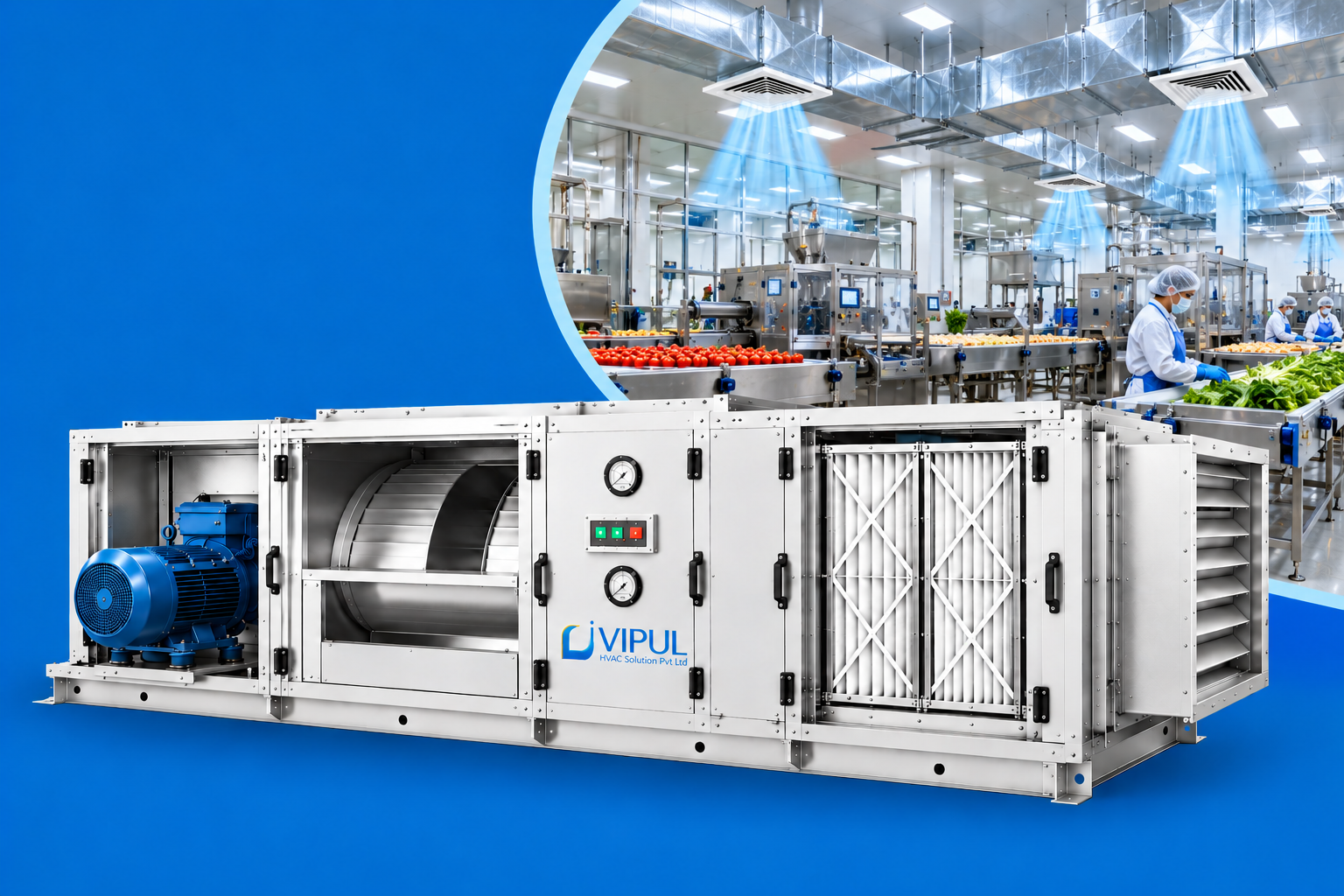
AHU for Food Processing Plants: Hygiene, Filtration & Temperature Control
Food processing plants require carefully designed HVAC and ventilation systems to support hygiene, temperature control, air filtration, ventilation and suitable environmental conditions for production areas.
Food-processing facilities may contain different environments, including production rooms, packaging areas, raw-material handling areas, cold rooms, storage spaces, laboratories and utility areas. Each area can have different HVAC requirements.
Vipul HVAC Solution Pvt Ltd provides AHU and HVAC solutions for food processing plants, including HVAC design, AHU selection, hygienic air handling, filtration, fresh-air ventilation, ducting, installation, controls, testing, commissioning and maintenance.
For food processing AHU and HVAC solutions, call +91 8000392000.
Company & Model Details
Treated Fresh Air Handling Unit
- AHU Selection & Customization
- Duct & Air Distribution Design
- Filtration & IAQ Planning
- Installation & Commissioning
- Maintenance Planning
- 2-Stage Unit
- Air Washer
What Is an AHU for Food Processing Plants?
An Air Handling Unit (AHU) for a food processing plant is designed to condition and distribute air to designated production and support areas.
Depending on the application, a food-processing AHU may include:
- Fresh-air intake section
- Return-air section
- Mixing section where appropriate
- Pre-filters
- Fine filters
- Cooling coils
- Heating/reheat systems where required
- Dehumidification
- Humidification where required
- Supply fans
- VFDs
- Control dampers
- Temperature sensors
- Humidity sensors
- Differential-pressure monitoring
- BMS integration
- Condensate drainage
- Access and maintenance sections
The exact configuration should be determined from the food process, hygiene requirements, room conditions, occupancy, heat load and applicable project requirements.
Why Is HVAC Important in Food Processing Plants?
Food processing facilities can have demanding environmental conditions.
Production processes may generate:
- Heat
- Moisture
- Steam
- Odors
- Dust
- Aerosols
- Process contaminants
The facility may also require controlled conditions for:
- Product handling
- Processing
- Packaging
- Storage
- Personnel comfort
- Equipment operation
- Hygiene management
A properly designed HVAC system can help establish appropriate environmental conditions while supporting the facility’s hygiene and contamination-control strategy.
Food Processing HVAC Design Requirements
HVAC design should begin with an understanding of the food-processing operation.
Important considerations can include:
- Production process
- Room function
- Temperature
- Relative humidity
- Fresh-air requirements
- Exhaust requirements
- Airflow direction
- Filtration
- Pressure relationships
- Heat loads
- Moisture loads
- Occupancy
- Cleaning processes
- Operating schedules
Different areas should not automatically be given the same HVAC design. Production, packaging, storage and utility spaces may have different requirements.
Hygienic AHU Design for Food Processing
Hygiene is a major consideration in food-processing HVAC design.
Depending on the application, AHU construction may consider:
- Smooth internal surfaces
- Cleanable surfaces
- Appropriate insulation
- Suitable drain-pan design
- Proper condensate drainage
- Access for cleaning and maintenance
- Appropriate filter sections
- Low-leakage construction
- Corrosion-resistant materials where required
- Minimized areas where moisture can accumulate
The appropriate AHU construction should be selected according to the process and facility hygiene requirements.
Temperature Control in Food Processing Plants
Temperature control can be important for food-processing operations and worker comfort.
Depending on the process, HVAC systems may need to control:
- Room temperature
- Supply-air temperature
- Return-air temperature
- Product-area environmental conditions
- Equipment heat loads
An AHU can incorporate cooling coils, heating systems and automatic temperature controls as required.
The required temperature range should be established according to the product, process and facility specifications.
Humidity Control for Food Processing
Humidity can influence certain food-processing operations, materials and building conditions.
High humidity can contribute to:
- Condensation
- Moisture accumulation
- Product/process issues
- Corrosion
- Uncomfortable working conditions
Depending on the application, an AHU may incorporate:
- Cooling-based dehumidification
- Reheat
- Dedicated dehumidification
- Humidification where required
- Humidity sensors
- Automatic controls
Humidity requirements should be determined from the specific food process and environmental requirements.
Filtration for Food Processing HVAC
Air filtration is an important component of food-processing HVAC systems.
A typical AHU filtration arrangement may include:
Fresh Air → Pre-Filter → Fine Filter → Cooling Coil → Fan → Supply Air
Additional filtration may be required for particular processes.
Filter selection should consider:
- Outdoor-air quality
- Required filtration efficiency
- Airflow
- Pressure drop
- Maintenance requirements
- Hygiene requirements
- Process conditions
The appropriate filtration strategy should be determined according to the facility’s environmental and process requirements.
Fresh Air & Ventilation for Food Processing
Fresh-air ventilation provides outdoor air to occupied and designated production areas.
A food-processing ventilation system may include:
- Fresh-air AHUs
- Supply-air fans
- Fresh-air ducts
- Exhaust fans
- Exhaust ducts
- Dampers
- Filters
- Make-up air
- BMS controls
Fresh-air and exhaust-air quantities should be designed according to room function, occupancy, process emissions and applicable ventilation criteria.
Airflow & Pressure Control
Airflow direction can be an important part of hygiene and contamination-control strategies.
Depending on the facility design, HVAC systems may establish pressure relationships between:
- Raw-material areas
- Processing rooms
- Packaging areas
- Corridors
- Utility rooms
- Waste-handling areas
The desired pressure strategy depends on the food process and contamination-control requirements.
AHU for Food Processing Production Areas
Production rooms may generate significant heat and moisture.
HVAC design can consider:
- Production equipment
- Workers
- Process heat
- Steam
- Moisture
- Fresh-air requirements
- Exhaust
- Cleaning operations
- Air distribution
The AHU capacity should be determined from the calculated cooling and ventilation loads.
AHU for Food Packaging Areas
Packaging areas may have different environmental requirements from production areas.
HVAC design can consider:
- Temperature
- Humidity
- Air cleanliness
- Occupancy
- Packaging machinery
- Fresh-air requirements
- Airflow direction
Where necessary, packaging areas can be separately zoned from other production areas.
AHU for Food Storage Areas
Food storage HVAC requirements depend on the product and storage conditions.
The HVAC system may need to control:
- Temperature
- Humidity
- Air circulation
- Ventilation
Some products require dedicated refrigeration or cold-storage systems rather than a conventional AHU. The appropriate system depends on the required storage conditions.
Industrial Ventilation for Food Processing
Food-processing facilities may require specialized exhaust and ventilation systems.
Potential applications include:
- Steam removal
- Heat removal
- Moisture removal
- Odor control
- Process exhaust
- Make-up air
- General ventilation
The exhaust system should be designed around the source and characteristics of the process emissions.
Food Processing HVAC Duct Design
Ductwork should be designed to distribute conditioned and filtered air effectively.
Important considerations include:
- Air velocity
- Static pressure
- Pressure losses
- Duct dimensions
- Insulation
- Leakage
- Cleanability
- Access
- Air balancing
- Fire and smoke requirements
Where hygiene is critical, duct construction and access should be coordinated with the overall cleaning and maintenance strategy.
Condensation Control
Condensation can be a concern in food-processing environments with high humidity and low-temperature surfaces.
HVAC design should consider:
- Insulation
- Surface temperatures
- Cooling-coil operation
- Condensate drainage
- Room humidity
- Air movement
Proper condensate management is important for maintaining suitable facility conditions.
HVAC Controls & BMS
A Building Management System (BMS) can provide centralized monitoring and control of food-processing HVAC equipment.
Parameters may include:
- AHU status
- Supply-air temperature
- Return-air temperature
- Room temperature
- Relative humidity
- Fan status
- VFD speed
- Filter differential pressure
- Damper position
- Valve position
- Room pressure
- Alarm conditions
BMS integration can help facility teams monitor HVAC performance and operating conditions.
Energy-Efficient HVAC for Food Processing Plants
Food-processing facilities can operate HVAC systems for extended periods.
Energy-efficiency measures may include:
VFD Fans
VFDs can adjust fan speed according to airflow requirements.
Efficient AHUs
Proper fan, coil and filter selection can help manage operating energy.
Zoning
Separate HVAC zones can allow systems to operate according to the requirements of individual areas.
Heat Recovery
Heat recovery can be considered for suitable fresh-air and exhaust-air applications.
BMS Controls
Automated scheduling and monitoring can help optimize HVAC operation.
Preventive Maintenance
Maintaining clean filters, coils and fans can help preserve system performance.
Testing & Commissioning
Testing and commissioning are important after installation.
Depending on the project requirements, activities can include:
- AHU performance testing
- Airflow measurement
- Supply-air balancing
- Return-air balancing
- Fresh-air measurement
- Exhaust-air measurement
- Temperature verification
- Humidity verification
- Pressure checks
- Filter differential-pressure checks
- Control-system testing
- BMS verification
Testing requirements should be established according to the facility’s process and project specifications.
Food Processing HVAC Maintenance
Regular preventive maintenance helps maintain HVAC performance.
Typical activities include:
- AHU inspection
- Filter cleaning/replacement
- Cooling-coil cleaning
- Drain-pan cleaning
- Condensate-drain inspection
- Fan inspection
- Motor inspection
- Belt inspection
- Bearing inspection
- Damper inspection
- Sensor calibration
- VFD inspection
- Duct inspection
- BMS checks
Maintenance frequency should be established according to the equipment, operating conditions and facility maintenance program.
Why Choose Vipul HVAC Solution Pvt Ltd?
Vipul HVAC Solution Pvt Ltd provides HVAC engineering and contracting solutions for food processing plants, factories, pharmaceutical facilities, commercial buildings and other specialized applications.
Our Food Processing HVAC Capabilities
- Food processing plant AHU systems
- Hygienic AHU solutions
- Food industry HVAC design
- Temperature control
- Humidity control
- Fresh-air ventilation
- Industrial ventilation
- Filtration systems
- Air distribution
- Pressure-control systems
- Food processing ducting
- AHU installation
- HVAC controls
- BMS integration
- Air balancing
- Testing and commissioning
- HVAC maintenance and AMC
Integrated HVAC Approach
We consider the complete system:
Process Requirements + Cooling Load + AHU + Filtration + Fresh Air + Exhaust + Ductwork + Air Distribution + Controls
This approach helps develop an HVAC solution around the actual requirements of the food-processing facility.
Our Food Processing HVAC Project Process
1. Site Assessment
We evaluate the plant layout, production process, equipment and existing HVAC infrastructure.
2. Process Assessment
We identify heat sources, moisture generation, occupancy, ventilation requirements and environmental conditions.
3. Cooling Load Calculation
Cooling and ventilation loads are calculated according to the project requirements.
4. Hygiene & Airflow Assessment
Room functions, airflow direction, filtration and pressure relationships are evaluated.
5. AHU Selection
AHU airflow, cooling capacity, static pressure, filtration and fan requirements are evaluated.
6. Duct & Air Distribution Design
Supply, return, fresh-air and exhaust ductwork is designed.
7. Installation
AHUs, ducts, piping, controls and associated HVAC systems are installed.
8. Testing & Commissioning
The system is balanced, tested and commissioned according to the approved project requirements.
Benefits of a Properly Designed Food Processing AHU
A properly engineered food-processing HVAC system can help provide:
- Controlled temperature
- Suitable humidity management
- Appropriate ventilation
- Effective air filtration
- Better air distribution
- Support for hygiene objectives
- Controlled environmental conditions
- Improved worker comfort
- Efficient HVAC operation
- Centralized monitoring
- Easier maintenance
Actual performance depends on proper design, equipment selection, installation, operation, maintenance and testing.
What is an AHU for food processing plants?
An AHU for food processing plants is an Air Handling Unit designed to condition and distribute air while supporting temperature, humidity, ventilation and filtration requirements.
Why is HVAC important in food processing?
HVAC helps control environmental conditions such as temperature, humidity, ventilation, filtration and airflow that can be important for food-processing operations and hygiene management.
What is a hygienic AHU?
A hygienic AHU is designed with features that support cleaning, maintenance and environmental-control requirements for applications where hygiene is important.
Is HEPA filtration required in food processing plants?
Not every food-processing area requires HEPA filtration. The appropriate filtration level depends on the process, environmental requirements, contamination-control strategy and project specifications.
How is temperature controlled in food processing areas?
Temperature can be controlled using cooling coils, heating systems, automatic valves, temperature sensors and HVAC control systems according to the required operating conditions.
Why is humidity control important in food processing?
Humidity can affect certain processes, materials, condensation conditions and worker comfort. The required humidity range depends on the specific application.
Can an AHU provide fresh air to food-processing areas?
Yes. An AHU can be configured to introduce and condition outdoor air according to the ventilation requirements of the facility.
Can food-processing HVAC systems control room pressure?
Yes. Supply, return and exhaust airflow can be designed to establish suitable pressure relationships between different areas where required.
Can food-processing AHUs be connected to BMS?
Yes. AHUs can be integrated with a BMS to monitor parameters such as temperature, humidity, fan status, filter pressure, room pressure and alarms.
Does Vipul HVAC Solution provide food processing AHU installation?
Yes. Vipul HVAC Solution Pvt Ltd provides AHU installation, ducting, filtration, controls, testing and commissioning services according to the project scope.
Does Vipul HVAC Solution provide HVAC maintenance for food processing plants?
Yes. Maintenance services can include AHU inspection, filter replacement, coil cleaning, drain inspection, fan and motor checks, controls and preventive maintenance.
How can I contact Vipul HVAC Solution Pvt Ltd?
For food processing AHU, hygienic HVAC, filtration, temperature-control and ventilation solutions, contact +91 8000392000.