
- Home
- About Us
-
Products
- Split Ac & Cassette Ac & Floor Stand Ac
- Ducted & Package Air Conditioning
- Vrf / Vrv Systems
- Ventilation Systems
- Fan Coil Units (Fcu)
- Haima Industrial Panel AC
- Air Handling Units (Ahu)
- Heat Pump System
- Bms & Hvac Automation
- Duct Work System
- Precision Air Conditioning (Pac)
- Chiller Systems
- Kitchen Exhaust & Smoke Management Systems
- Flame Proof Ac / Explosion Proof Ac
- Services
- Blogs
- Contact Us
AHU for Textile Industries
Home >AHU for Textile Industries
An AHU for textile industries is an important component of a textile mill HVAC system. A properly designed AHU can condition and distribute air while supporting temperature control, humidity management, fresh-air ventilation, filtration and uniform airflow across production areas.
All Products
need any help ?
24/7 direct call
+91 800-0392-000
info@vipulhvacsolution.in
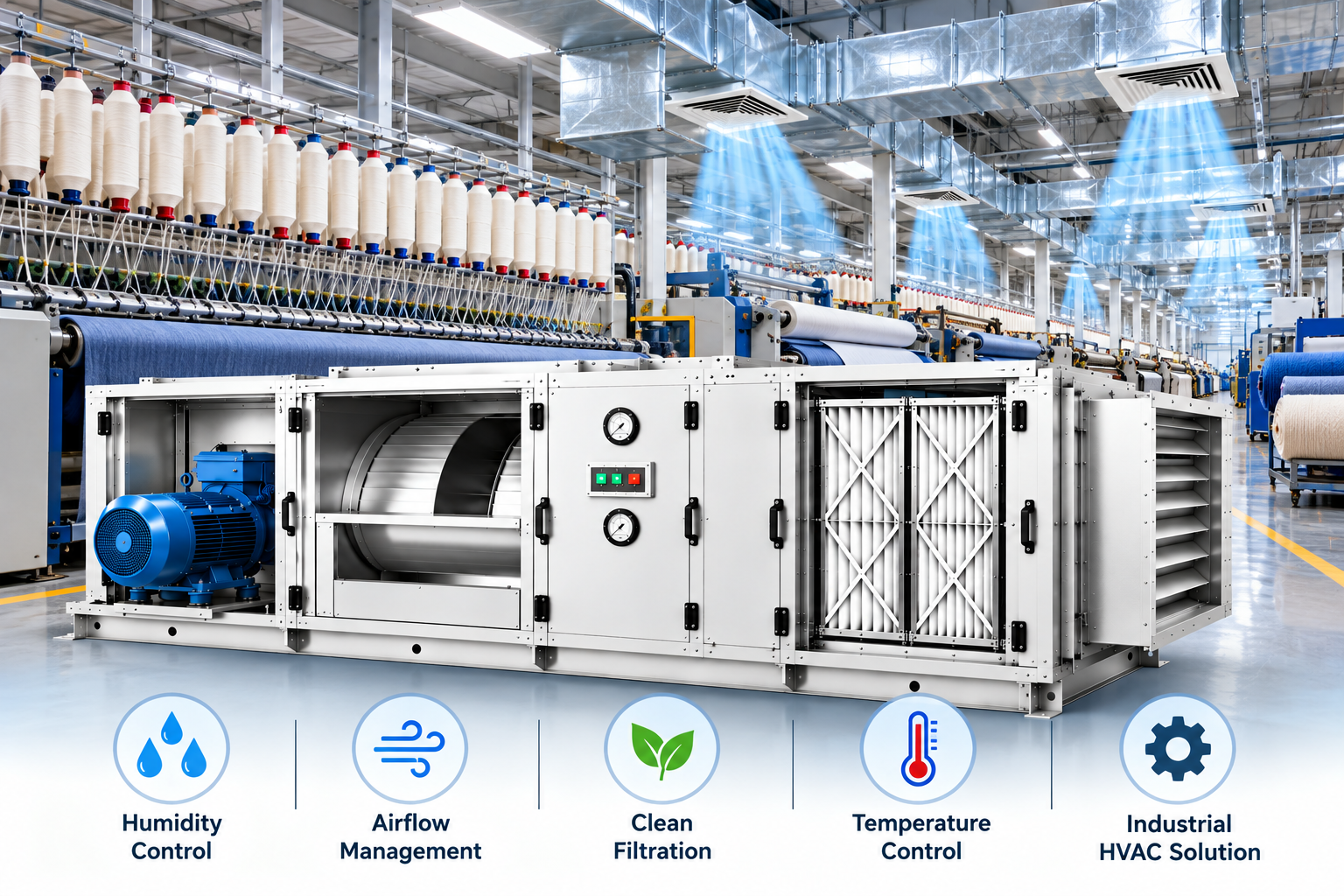
AHU for Textile Industries: Humidity Control, Airflow & HVAC Applications
Textile manufacturing requires carefully controlled environmental conditions because temperature, humidity, airflow and ventilation can influence production processes, material handling, worker comfort and equipment operation.
Textile facilities can include spinning, weaving, knitting, dyeing, printing, finishing, garment production, storage and other processes. Each area can have different HVAC requirements.
Vipul HVAC Solution Pvt Ltd provides HVAC and AHU solutions for textile industries, including HVAC design, load calculation, humidity-control systems, AHU selection, ventilation, ducting, installation, controls, testing, commissioning and maintenance.
For textile AHU and HVAC solutions, call +91 8000392000.
What Is an AHU for Textile Industries?
An Air Handling Unit (AHU) for textile industries is designed to condition and distribute air throughout textile production and support areas.
Depending on the application, a textile AHU can include:
- Fresh-air intake section
- Return-air section
- Mixing section where applicable
- Pre-filters
- Fine filters
- Cooling coils
- Heating coils where required
- Humidification system
- Dehumidification system
- Supply fan
- VFD
- Control dampers
- Temperature sensors
- Humidity sensors
- Differential-pressure monitoring
- BMS integration
- Condensate drainage
- Access and maintenance sections
The AHU configuration should be selected according to the textile process, production equipment, room conditions, heat load and required humidity range.
Why Is HVAC Important in Textile Industries?
Textile production can be sensitive to environmental conditions.
Changes in temperature and humidity can affect:
- Yarn characteristics
- Fiber behavior
- Static electricity
- Machine performance
- Yarn breakage
- Production efficiency
- Fabric handling
- Worker comfort
- Dust and lint conditions
The required environmental conditions vary according to the fiber, process, machinery and production stage.
A properly engineered HVAC system can help maintain more consistent environmental conditions.
Textile HVAC Design Requirements
Textile HVAC design should begin with an understanding of the production process.
Important considerations include:
- Textile process
- Fiber type
- Machinery
- Production rate
- Heat generation
- Room dimensions
- Occupancy
- Outdoor conditions
- Temperature
- Relative humidity
- Fresh-air requirement
- Filtration
- Airflow pattern
- Exhaust requirements
- Operating schedule
Different textile departments may require different HVAC strategies.
Humidity Control in Textile Industries
Humidity control is one of the most important HVAC considerations in many textile manufacturing processes.
Relative humidity can influence the behavior of textile fibers and yarns.
Depending on the material and process, suitable humidity can help manage:
- Static electricity
- Fiber moisture
- Yarn strength
- Yarn flexibility
- Fiber breakage
- Dust and lint behavior
- Machine performance
The optimum humidity range should be established according to the specific textile material, process and manufacturer’s production requirements.
Humidification Systems for Textile Mills
Textile factories may use dedicated humidification systems to maintain the required relative humidity.
Possible humidification technologies include:
- High-pressure humidification
- Spray humidification
- Air-washer systems
- Evaporative humidification
- Steam humidification where appropriate
The selection depends on:
- Required humidity
- Room volume
- Production process
- Water quality
- Operating conditions
- Maintenance requirements
Humidification should be properly integrated with the AHU and HVAC control system.
Dehumidification for Textile Industries
Some textile processes require humidity to be controlled downward rather than increased.
Dehumidification can be achieved using:
- Cooling coils
- Reheat systems
- Dedicated dehumidifiers
- Desiccant systems where appropriate
- Controlled fresh-air systems
The appropriate method depends on the required humidity level and outdoor conditions.
Airflow Design for Textile Mills
Uniform airflow is important in large textile production areas.
HVAC design should consider:
- Supply-air quantity
- Return-air quantity
- Air velocity
- Room volume
- Machine layout
- Heat sources
- Humidity distribution
- Fresh-air requirements
- Exhaust requirements
Poor air distribution can create areas with different temperature and humidity conditions.
AHU for Spinning Mills
Spinning departments can generate heat, lint and dust while operating large numbers of textile machines.
The HVAC system may need to address:
- Temperature
- Relative humidity
- Heat removal
- Lint and dust management
- Air distribution
- Fresh air
- Exhaust
- Worker comfort
Special attention should be given to airflow patterns around spinning machinery.
AHU for Weaving Mills
Weaving operations can produce heat and textile-related airborne particles.
HVAC design may address:
- Temperature control
- Humidity control
- Air distribution
- Heat removal
- Dust/lint management
- Fresh-air ventilation
- Exhaust requirements
The system should be designed around the machinery layout and production requirements.
AHU for Textile Dyeing & Processing
Dyeing and wet-processing areas can generate substantial heat and moisture.
HVAC systems may need to address:
- High humidity
- Steam
- Process heat
- Moisture removal
- Exhaust
- Fresh air
- Worker comfort
Dedicated process-exhaust systems may be required in addition to the general HVAC system.
AHU for Garment Manufacturing
Garment production areas may have different HVAC requirements from spinning or weaving departments.
HVAC design can consider:
- Worker occupancy
- Sewing machines
- Lighting
- Equipment heat
- Fresh-air requirements
- Temperature
- Humidity
- Air distribution
Suitable zoning can help provide different operating conditions in different production areas.
Textile Factory Ventilation
Ventilation is important for removing unwanted heat, moisture, dust and process-related contaminants.
A textile ventilation system can include:
- Fresh-air fans
- Exhaust fans
- AHUs
- Supply-air ducts
- Exhaust ducts
- Louvers
- Filters
- Make-up-air systems
- Air washers
- Humidification equipment
- BMS controls
The ventilation strategy should be designed according to the production process and building conditions.
Textile HVAC Filtration
Filtration can help manage airborne particulate matter and textile-related dust.
A textile AHU may include:
Fresh Air → Pre-Filter → Fine Filter → Cooling Coil → Fan → Supply Air
Additional filtration or dust-control equipment may be required for specific processes.
Filter selection should consider:
- Outdoor-air quality
- Textile dust levels
- Required filtration efficiency
- Airflow
- Pressure drop
- Maintenance requirements
Temperature Control in Textile Plants
Temperature control contributes to both process conditions and worker comfort.
An AHU system can incorporate:
- Cooling coils
- Heating coils
- Temperature sensors
- Automatic control valves
- VFD-controlled fans
- BMS controls
The required temperature range should be established according to the textile process and operating requirements.
Textile HVAC Duct Design
Ductwork distributes conditioned air throughout textile production areas.
Important design considerations include:
- Air velocity
- Static pressure
- Pressure losses
- Duct dimensions
- Insulation
- Leakage
- Machine layout
- Air distribution
- Maintenance access
- Air balancing
Large textile halls may require carefully designed supply and return arrangements to achieve uniform environmental conditions.
Energy-Efficient HVAC for Textile Industries
Textile plants can operate HVAC systems for long periods, making energy management important.
Potential energy-saving strategies include:
VFD Fans
Variable Frequency Drives can adjust fan speed according to airflow requirements.
Efficient AHUs
Proper fan and coil selection can help reduce unnecessary energy consumption.
Humidity Control Optimization
Maintaining the required humidity rather than unnecessarily over-humidifying or dehumidifying can help manage energy use.
Heat Recovery
Heat recovery may be considered for suitable fresh-air and exhaust-air applications.
Zoning
Separate HVAC zones can allow different departments to operate according to their specific requirements.
BMS Controls
Automated monitoring and scheduling can help optimize HVAC operation.
Textile HVAC Controls & BMS
A Building Management System (BMS) can monitor and control textile HVAC equipment.
Parameters may include:
- AHU status
- Supply-air temperature
- Return-air temperature
- Room temperature
- Relative humidity
- Fan status
- VFD speed
- Filter differential pressure
- Humidifier status
- Dehumidification status
- Damper position
- Valve position
- Alarm conditions
BMS integration can help operators monitor environmental conditions across textile production areas.
Testing & Commissioning
Textile HVAC systems should be properly tested and commissioned after installation.
Depending on the project requirements, commissioning can include:
- AHU performance testing
- Airflow measurement
- Supply-air balancing
- Return-air balancing
- Fresh-air measurement
- Exhaust-air measurement
- Temperature verification
- Humidity verification
- Pressure checks
- Humidification-system testing
- Control-system verification
- BMS testing
Proper commissioning helps verify that the HVAC system operates according to the approved design.
Textile HVAC Maintenance
Regular maintenance is important for reliable HVAC operation.
Typical maintenance activities include:
- AHU inspection
- Filter cleaning/replacement
- Cooling-coil cleaning
- Condensate-drain cleaning
- Fan inspection
- Motor inspection
- Belt inspection
- Bearing inspection
- Humidifier inspection
- Nozzle inspection where applicable
- Water-system inspection
- Damper inspection
- Sensor calibration
- VFD inspection
- Duct inspection
- BMS checks
Maintenance frequency should be determined according to equipment and operating conditions.
Why Choose Vipul HVAC Solution Pvt Ltd?
Vipul HVAC Solution Pvt Ltd provides HVAC engineering and contracting solutions for textile mills, manufacturing plants, industrial facilities and commercial buildings.
Our Textile HVAC Capabilities
- Textile industry AHU systems
- Textile HVAC design
- Textile humidity-control systems
- Humidification systems
- Dehumidification systems
- Textile ventilation
- Fresh-air systems
- Industrial air conditioning
- Filtration systems
- Air distribution
- Textile ducting
- AHU installation
- HVAC controls
- BMS integration
- Air balancing
- Testing and commissioning
- HVAC maintenance and AMC
Integrated Textile HVAC Approach
We consider:
Process Requirements + Cooling Load + AHU + Humidity Control + Fresh Air + Filtration + Airflow + Ductwork + Controls
This integrated approach helps develop HVAC systems according to the specific environmental requirements of textile production.
Our Textile HVAC Project Process
1. Site Assessment
We evaluate the textile plant layout, machinery, production process and existing HVAC infrastructure.
2. Process Assessment
We identify heat sources, humidity requirements, dust/lint generation and ventilation requirements.
3. Cooling Load Calculation
Cooling and ventilation loads are calculated according to project parameters.
4. Humidity Assessment
Required temperature and relative humidity conditions are established according to the textile process.
5. AHU Selection
AHU airflow, cooling capacity, static pressure, filtration and fan requirements are evaluated.
6. Humidification/Dehumidification Design
Where required, suitable humidity-control equipment is integrated into the HVAC system.
7. Duct & Air Distribution Design
Supply, return, fresh-air and exhaust ductwork is designed.
8. Installation & Commissioning
AHUs, ductwork, humidity-control equipment, controls and associated systems are installed, tested and commissioned.
Benefits of a Properly Designed Textile AHU
A properly engineered textile HVAC system can help provide:
- More consistent temperature
- Controlled relative humidity
- Better airflow distribution
- Support for textile-process requirements
- Improved worker comfort
- Dust and lint management
- Appropriate fresh-air ventilation
- Efficient HVAC operation
- Centralized monitoring
- Easier maintenance
Actual performance depends on the textile process, design parameters, equipment selection, installation, operation and maintenance.
Company & Model Details
Treated Fresh Air Handling Unit
- AHU Selection & Customization
- Duct & Air Distribution Design
- Filtration & IAQ Planning
- Installation & Commissioning
- Maintenance Planning
- 2-Stage Unit
- Air Washer
What is an AHU for textile industries?
An AHU for textile industries is an Air Handling Unit designed to condition and distribute air while supporting temperature, humidity, ventilation and filtration requirements in textile production areas.
Why is humidity control important in textile mills?
Humidity can influence fiber and yarn behavior, static electricity, yarn breakage, dust/lint conditions and machine operation. The required humidity depends on the textile material and process.
What type of humidification system is used in textile industries?
Textile plants may use high-pressure humidification, spray systems, air washers, evaporative humidification or other suitable technologies depending on the process and required humidity.
Can AHUs control humidity in textile factories?
Yes. AHUs can be integrated with humidification and dehumidification systems to help maintain the required environmental conditions.
What is the ideal humidity for a textile mill?
There is no single humidity value suitable for every textile process. The required relative humidity depends on the fiber, yarn, machinery and production process.
Does textile HVAC require fresh air?
Fresh-air requirements depend on occupancy, production processes, exhaust requirements and applicable ventilation criteria.
Can textile AHUs control temperature?
Yes. AHUs can use cooling coils, heating systems, sensors and automatic controls to maintain the required temperature range.
How can textile HVAC energy consumption be reduced?
Strategies can include efficient AHUs, VFD fans, appropriate humidity control, zoning, heat recovery where suitable, BMS controls and preventive maintenance.
Can textile AHUs be connected to BMS?
Yes. Textile AHUs can be integrated with BMS for monitoring and control of temperature, humidity, fan operation, filters, dampers and alarms.
Does Vipul HVAC Solution provide textile AHU installation?
Yes. Vipul HVAC Solution Pvt Ltd provides textile AHU installation, ducting, ventilation, humidity-control systems, controls, testing and commissioning according to project requirements.
Does Vipul HVAC Solution provide textile humidity-control systems?
Yes. Humidification and dehumidification solutions can be integrated with textile HVAC systems according to the required process conditions.
How can I contact Vipul HVAC Solution Pvt Ltd?
For textile AHU, humidity control, ventilation, air conditioning and HVAC solutions, contact +91 8000392000.