
- Home
- About Us
-
Products
- Split Ac & Cassette Ac & Floor Stand Ac
- Ducted & Package Air Conditioning
- Vrf / Vrv Systems
- Ventilation Systems
- Fan Coil Units (Fcu)
- Haima Industrial Panel AC
- Air Handling Units (Ahu)
- Heat Pump System
- Bms & Hvac Automation
- Duct Work System
- Precision Air Conditioning (Pac)
- Chiller Systems
- Kitchen Exhaust & Smoke Management Systems
- Flame Proof Ac / Explosion Proof Ac
- Services
- Blogs
- Contact Us
VRF System for Hotels and Restaurants
Home > VRF System for Hotels and Restaurants
Looking for the best VRF system for hotels and restaurants? Discover benefits, costs, energy savings, installation tips, and commercial HVAC solutions by Vipul HVAC Solution Pvt Ltd.
All Products
Looking for the Best VRF System for Your Hotel or Restaurant?
Comfort is Just a Click Away!
need any help ?
24/7 direct call
+91 800-0392-000
24/7 direct call
info@vipulhvacsolution.in
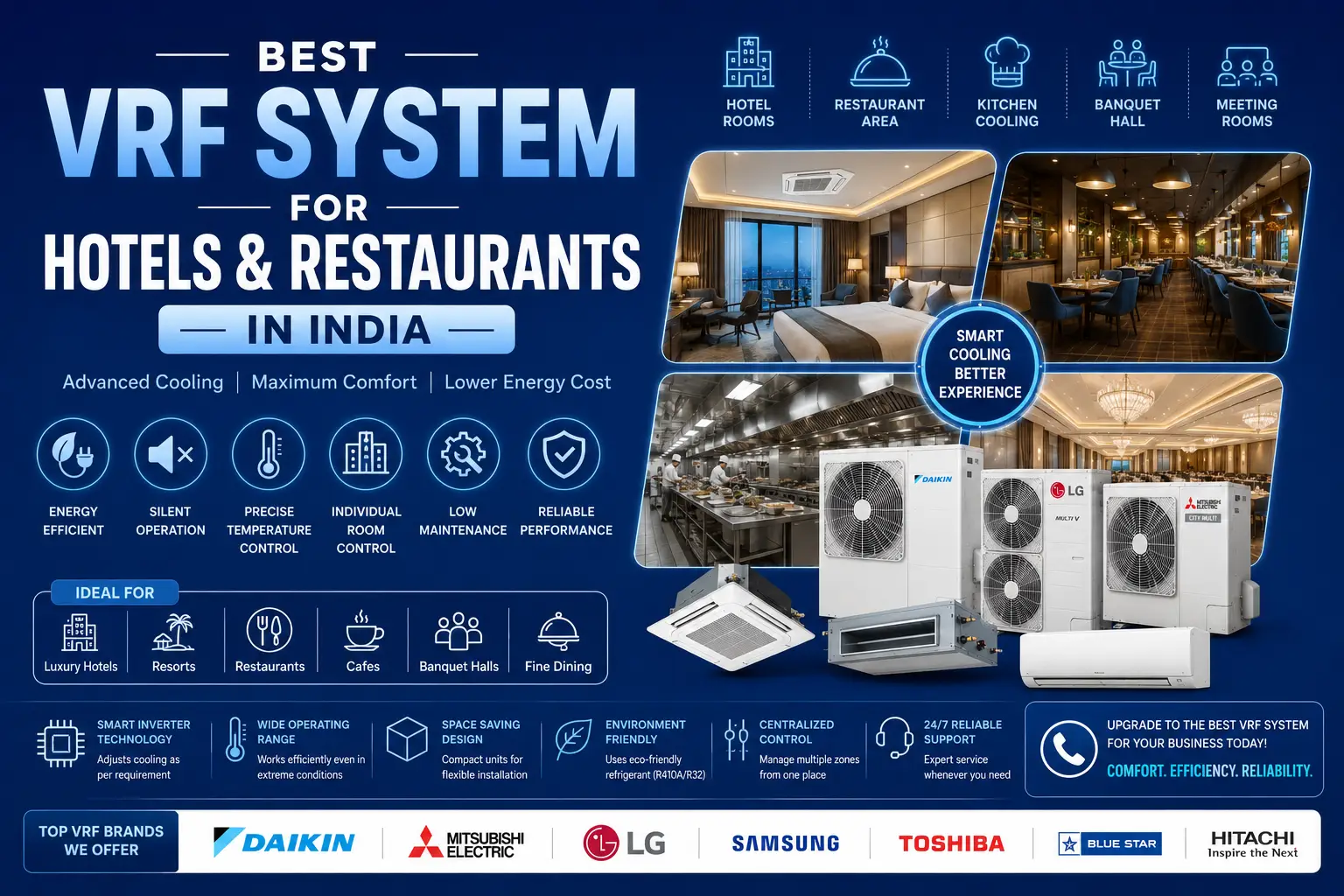
VRF System for Hotels and Restaurants
The hospitality industry depends heavily on comfort, ambience, and energy efficiency. Whether it is a luxury hotel, boutique resort, fine dining restaurant, café, banquet hall, or cloud kitchen, maintaining the perfect indoor temperature is essential for customer satisfaction and operational success.
Traditional HVAC systems often struggle to deliver flexibility, zoning control, and energy savings required in modern hospitality spaces. This is where VRF systems become the ideal solution.
A Variable Refrigerant Flow (VRF) system is one of the most advanced and energy-efficient HVAC technologies available today. It offers precise temperature control, silent operation, intelligent zoning, and significant energy savings, making it the preferred choice for hotels and restaurants across India.
As commercial buildings continue to focus on sustainability, comfort, and operational efficiency, VRF air conditioning systems are rapidly replacing conventional ducted and split AC systems.
What is a VRF System?
A VRF (Variable Refrigerant Flow) system is an advanced centralized air conditioning solution that uses refrigerant as the cooling and heating medium. The system intelligently controls the amount of refrigerant flowing to multiple indoor units based on the cooling or heating demand of different rooms or zones.
Unlike conventional HVAC systems, VRF systems provide independent temperature control for each area while using a single outdoor unit connected to multiple indoor units.
VRF systems are especially suitable for:
Hotels
Restaurants
Banquet halls
Resorts
Cafés
Office buildings
Hospitals
Shopping complexes
Commercial buildings
The system continuously adjusts compressor speed through inverter technology, ensuring high energy efficiency and precise comfort.
How Does a VRF System Work?
A VRF system consists of:
Outdoor unit
Indoor units
Refrigerant piping network
Branch selector units
Smart controllers
Thermostats
The outdoor unit contains inverter compressors that regulate refrigerant flow according to the cooling load.
Each indoor unit can independently control:
Temperature
Fan speed
Operation mode
Airflow direction
The VRF system automatically adjusts refrigerant flow to maintain desired room conditions without wasting energy.
This intelligent operation reduces electricity consumption while maintaining consistent comfort.
Why Hotels Need VRF Systems
Hotels require a sophisticated HVAC solution because different areas have different cooling demands throughout the day.
For example:
Guest rooms require individual temperature control
Lobbies need continuous cooling
Restaurants experience variable occupancy
Banquet halls require high cooling during events
Corridors require moderate airflow
Conference rooms need flexible cooling
A VRF system handles all these requirements efficiently.
Key Benefits of VRF Systems for Hotels
1. Individual Room Temperature Control
Every guest room can maintain its own temperature setting without affecting other rooms.
This improves:
Guest comfort
Customer satisfaction
Energy efficiency
Occupancy experience
Guests can personalize room temperature according to their preferences.
2. Energy Savings
Hotels consume massive amounts of electricity through HVAC systems.
VRF systems use inverter compressor technology that operates only according to actual cooling demand.
Benefits include:
Lower electricity bills
Reduced peak power demand
Improved operational efficiency
Lower running costs
Many hotels achieve 30% to 45% energy savings compared to conventional systems.
3. Silent Operation
Noise control is critical in hotels.
VRF systems provide:
Quiet indoor operation
Low outdoor unit noise
Minimal vibration
Better guest experience
This makes VRF ideal for luxury hospitality projects.
4. Flexible Installation
Hotels often have complex architectural designs.
VRF systems allow:
Long refrigerant piping
Flexible indoor unit placement
Compact equipment installation
Reduced ducting requirements
This flexibility helps architects and designers optimize space.
5. Modern Aesthetics
VRF indoor units are sleek and stylish.
Hotels can choose from:
Cassette units
Concealed duct units
Wall-mounted units
Floor-standing units
Ceiling suspended units
This improves interior aesthetics.
6. Simultaneous Heating and Cooling
Some advanced VRF systems can provide heating and cooling simultaneously in different zones.
For example:
Sunny rooms may require cooling
Shaded rooms may need heating
Heat recovery VRF systems manage this efficiently.
Why Restaurants Need VRF Systems
Restaurants have unique HVAC challenges due to:
High occupancy
Kitchen heat loads
Frequent door opening
Variable seating density
Indoor air quality requirements
Comfort expectations
VRF systems are highly effective for restaurants because they provide fast, efficient, and flexible cooling.
Benefits of VRF Systems for Restaurants
1. Consistent Customer Comfort
Comfortable dining environments improve customer experience.
VRF systems maintain stable indoor temperatures even during peak hours.
2. Reduced Operating Costs
Restaurants operate for long hours.
VRF technology minimizes energy wastage through:
Variable compressor speed
Zoning control
Smart operation
Occupancy-based cooling
This reduces monthly electricity expenses.
3. Space Saving Design
Restaurants often have limited service space.
VRF systems require:
Less ducting
Compact outdoor units
Flexible piping routes
Minimal ceiling space
This allows better utilization of commercial areas.
4. Better Air Distribution
Uneven cooling can affect customer comfort.
VRF systems provide:
Uniform airflow
Precise temperature management
Multi-zone cooling
Enhanced indoor comfort
5. Stylish Interior Integration
Modern restaurants focus heavily on aesthetics.
VRF indoor units blend seamlessly into:
Fine dining interiors
Cafes
Luxury restaurants
Rooftop dining spaces
Banquet areas
Applications of VRF Systems in Hospitality Industry
VRF systems can be installed in various hospitality applications.
Hotel Applications
Guest Rooms
Each room gets independent temperature control.
Hotel Lobby
Large spaces receive efficient centralized cooling.
Conference Rooms
Flexible cooling during meetings and events.
Banquet Halls
High-capacity cooling for gatherings.
Corridors
Efficient cooling with reduced energy consumption.
Gym and Spa Areas
Comfortable environment for wellness facilities.
Restaurants and Cafes
Consistent cooling for customer satisfaction.
Restaurant Applications
Fine Dining Restaurants
Premium comfort with silent operation.
Fast Food Chains
Quick and efficient cooling.
Cloud Kitchens
Efficient temperature management.
Banquet Restaurants
Flexible zoning and large-area cooling.
Cafes
Stylish and comfortable indoor atmosphere.
Rooftop Restaurants
Advanced climate control solutions.
Types of VRF Systems
There are mainly three types of VRF systems.
1. Heat Pump VRF System
This system provides either cooling or heating at a time.
Best for:
Restaurants
Small hotels
Commercial offices
Advantages:
Lower installation cost
Simple operation
Energy efficient
2. Heat Recovery VRF System
This advanced system provides simultaneous heating and cooling.
Best for:
Luxury hotels
Large commercial buildings
Multi-zone projects
Advantages:
Maximum energy efficiency
Superior comfort
Heat recovery capability
3. Cooling Only VRF System
Primarily used in regions with hot climates.
Best for:
Indian hospitality projects
Restaurants
Commercial spaces
Major Components of a VRF System
Outdoor Unit
Contains:
Inverter compressor
Condenser coil
Fans
Refrigerant control system
Indoor Units
Available in multiple styles:
Cassette type
Ductable type
Wall mounted type
Ceiling suspended type
Floor standing type
Refrigerant Piping
Copper piping circulates refrigerant between indoor and outdoor units.
Controllers
Includes:
Wired controllers
Wireless remotes
Centralized management systems
Smart building integration
Advantages of VRF Systems Over Traditional HVAC Systems
| Feature | VRF System | Traditional HVAC |
|---|---|---|
| Energy Efficiency | Very High | Moderate |
| Temperature Control | Individual Zone Control | Limited |
| Installation Flexibility | Excellent | Moderate |
| Noise Level | Very Low | Higher |
| Space Requirement | Compact | Larger |
| Maintenance | Lower | Higher |
| Aesthetic Integration | Excellent | Moderate |
| Energy Savings | High | Average |
| Scalability | Easy | Difficult |
Energy Efficiency of VRF Systems
Energy efficiency is one of the biggest reasons hotels and restaurants choose VRF systems.
How VRF Saves Energy
Inverter Technology
The compressor operates at variable speeds instead of full ON/OFF cycles.
Zoning Control
Only occupied areas receive cooling.
Heat Recovery
Heat from one area can be reused elsewhere.
Smart Sensors
Automatic adjustment based on occupancy and load.
Reduced Duct Losses
Minimal ducting improves efficiency.
Detailed VRF Installation Process for Hotels and Restaurants
Installing a VRF (Variable Refrigerant Flow) system in hotels and restaurants requires expert HVAC engineering, accurate heat load calculations, professional refrigerant piping, and proper commissioning. A correctly installed VRF system delivers maximum energy efficiency, silent operation, long equipment life, and superior indoor comfort.
Unlike conventional air conditioning systems, VRF technology is highly advanced and must be installed by experienced HVAC professionals to ensure reliable performance.
Step 1: Site Inspection and HVAC Consultation
The installation process begins with a detailed site survey conducted by HVAC engineers.
During inspection, the following factors are analyzed:
- Building layout
- Number of floors
- Ceiling height
- Occupancy levels
- Kitchen heat load
- Fresh air requirements
- Glass façade exposure
- Electrical infrastructure
- Ventilation requirements
- Space for outdoor units
Hotels and restaurants require different cooling strategies for different areas.
| Area | HVAC Requirement |
|---|---|
| Hotel Rooms | Individual temperature control |
| Lobby | Continuous cooling |
| Restaurant Dining Area | Uniform airflow |
| Kitchen | Ventilation and exhaust |
| Banquet Hall | High-capacity cooling |
| Conference Room | Flexible occupancy cooling |
Proper planning ensures maximum energy savings and better cooling performance.
Step 2: Heat Load Calculation
Heat load calculation is one of the most critical parts of VRF system design.
Professional HVAC engineers calculate:
- Occupancy heat load
- Lighting heat load
- Equipment heat load
- Solar heat gain
- Outdoor temperature conditions
- Ventilation load
- Kitchen load
- Humidity levels
Accurate heat load calculations help prevent:
- Oversized systems
- High electricity bills
- Uneven cooling
- Compressor damage
- Excess humidity
The cooling load is measured in:
- Tons (TR)
- BTU/hr
- kW
Step 3: VRF System Design
After heat load calculation, the complete HVAC system layout is designed.
This includes:
Indoor Unit Selection
Different indoor units are selected according to interior design and cooling requirements.
Types include:
- Cassette units
- Concealed duct units
- Wall-mounted units
- Floor-standing units
- Ceiling suspended units
Outdoor Unit Placement
Outdoor units are installed in locations with:
- Proper ventilation
- Structural stability
- Easy maintenance access
- Low noise impact
Refrigerant Piping Layout
Copper piping is carefully designed to ensure:
- Proper refrigerant flow
- Low pressure drop
- Efficient oil return
- Leak-free performance
Step 4: Electrical and Drainage Planning
The VRF system requires proper electrical infrastructure.
The design includes:
- Power supply planning
- MCCB selection
- Earthing systems
- Communication wiring
- Controller wiring
Drainage systems are also designed to prevent:
- Water leakage
- Ceiling damage
- Drain blockage
Step 5: VRF Equipment Installation
The installation stage includes:
- Indoor unit mounting
- Outdoor unit installation
- Copper piping installation
- Insulation work
- Electrical wiring
- Drain piping
- Controller setup
Proper installation improves:
- Cooling performance
- Energy efficiency
- Equipment life
- Noise reduction
Step 6: Vacuuming and Refrigerant Charging
Before startup, the refrigerant piping network is vacuumed to remove:
- Moisture
- Air contamination
- Dust particles
Refrigerant charging is done according to manufacturer specifications.
Improper charging can reduce cooling performance and damage compressors.
Step 7: Testing and Commissioning
Final testing ensures proper system operation.
The commissioning process includes:
- Pressure testing
- Temperature testing
- Controller calibration
- Airflow balancing
- Refrigerant leak testing
- Electrical testing
After successful testing, the system is handed over for operation.
Comprehensive VRF System Cost Section
The cost of a VRF system for hotels and restaurants depends on multiple technical and commercial factors. While VRF systems have a higher initial investment compared to conventional AC systems, they provide long-term savings through lower electricity consumption and reduced maintenance costs.
Factors Affecting VRF System Cost
1. Building Size
Larger hotels and restaurants require higher cooling capacity and more indoor units, increasing project cost.
2. Cooling Capacity
The total tonnage requirement directly affects:
- Outdoor unit size
- Indoor unit quantity
- Refrigerant piping cost
3. Type of Indoor Units
Different indoor units have different pricing.
Examples include:
- Cassette AC units
- Concealed duct units
- Wall-mounted units
- Ceiling suspended units
4. Brand Selection
Premium brands generally cost more but provide:
- Better efficiency
- Higher reliability
- Advanced automation
- Longer lifespan
5. Installation Complexity
Project complexity affects overall installation cost.
Factors include:
- Multi-floor buildings
- Long piping routes
- High ceilings
- Structural challenges
- Banquet hall requirements
Approximate VRF System Cost in India
| Application | Estimated Cost |
|---|---|
| Small Café | ₹4 Lakh – ₹8 Lakh |
| Mid-Size Restaurant | ₹10 Lakh – ₹25 Lakh |
| Banquet Hall | ₹20 Lakh – ₹60 Lakh |
| Boutique Hotel | ₹15 Lakh – ₹50 Lakh |
| Luxury Hotel | ₹50 Lakh – ₹5 Crore+ |
Actual cost depends on detailed HVAC design and site conditions.
Additional Project Costs
Apart from equipment, the total HVAC budget may include:
- Copper piping
- Insulation
- Electrical wiring
- Controllers
- Ventilation systems
- Installation labor
- Testing and commissioning
- AMC maintenance
Long-Term Savings with VRF Systems
VRF systems help reduce:
- Electricity bills
- Maintenance expenses
- Compressor wear
- Downtime
Many hospitality projects recover their investment through energy savings within a few years.
Advanced VRF Brand Comparison
Choosing the right VRF brand is important for long-term HVAC performance, energy efficiency, and maintenance reliability.
VRF Brand Comparison Table
| Brand | Best For | Energy Efficiency | Key Advantage |
|---|---|---|---|
| Daikin VRV | Luxury Hotels | Excellent | Industry-leading reliability |
| Mitsubishi Electric | Premium Hospitality | Excellent | Ultra-quiet operation |
| LG Multi V | Restaurants & Offices | Very Good | Smart automation |
| Toshiba VRF | Commercial Projects | Very Good | Compact design |
| Samsung DVM | Modern Buildings | Good | Advanced controls |
| Carrier VRF | Large Commercial Buildings | Good | Strong commercial support |
Daikin VRV
Daikin is one of the most trusted VRF brands globally.
Advantages
- Excellent energy efficiency
- Advanced inverter technology
- Reliable performance
- Strong service network
Best Applications
- Luxury hotels
- Resorts
- Banquet halls
- Premium restaurants
Mitsubishi Electric VRF
Known for premium quality and silent operation.
Advantages
- Ultra-low noise
- Precision cooling
- Long lifespan
- Stable performance
Best Applications
- Boutique hotels
- Fine dining restaurants
- Executive hospitality projects
LG Multi V
LG offers smart and modern VRF systems.
Advantages
- Smart controls
- Wi-Fi connectivity
- Competitive pricing
- Stylish indoor units
Best Applications
- Restaurants
- Cafés
- Commercial offices
Toshiba VRF
Toshiba systems are known for compact design and efficiency.
Advantages
- Energy-saving operation
- Reliable compressors
- Space-saving design
Best Applications
- Commercial spaces
- Hotels
- Restaurants
Samsung DVM
Samsung offers modern VRF technology with automation features.
Advantages
- Smart building integration
- Advanced control systems
- Modern aesthetics
Best Applications
- Modern hospitality projects
- Commercial buildings
Carrier VRF
Carrier is highly trusted in commercial HVAC projects.
Advantages
- Strong engineering support
- Reliable cooling performance
- Commercial-grade systems
Best Applications
- Large hotels
- Commercial buildings
- Industrial-commercial projects
Looking for the Best VRF System for Your Hotel or Restaurant?
Vipul HVAC Solution Pvt Ltd provides complete commercial HVAC and VRF system solutions for:
- Hotels
- Restaurants
- Resorts
- Banquet halls
- Cafes
- Commercial buildings
- Offices
- Hospitals
We specialize in:
- VRF & VRV system installation
- Commercial HVAC design
- Heat load calculation
- Ventilation systems
- Energy-efficient HVAC solutions
- HVAC AMC services
- HVAC consultancy
- HVAC retrofit projects
Why Choose Us?
Experienced HVAC Engineers
Professional project planning and execution.
Customized HVAC Solutions
Tailor-made systems according to project requirements.
Energy-Efficient Designs
Reduce electricity consumption and operating costs.
Professional Installation
High-quality workmanship for long-term reliability.
Reliable After-Sales Support
Fast maintenance and technical assistance.
Contact Vipul HVAC Solution Pvt Ltd Today
Get professional consultation for:
- Hotel HVAC systems
- Restaurant air conditioning
- VRF installation
- Commercial heat load calculation
- Energy-saving HVAC projects
Upgrade your hospitality project with advanced VRF technology and experience superior comfort, energy savings, and reliable cooling performance.
FAQ – VRF System for Hotels and Restaurants
What is a VRF system?
A VRF system is an advanced HVAC solution that controls refrigerant flow according to the cooling demand of different rooms or zones.
Is VRF suitable for hotels?
Yes, VRF systems are ideal for hotels because they provide individual room control, energy savings, and silent operation.
Why are VRF systems preferred for restaurants?
VRF systems provide fast cooling, better airflow, lower electricity consumption, and flexible installation.
How much energy can VRF systems save?
VRF systems can reduce energy consumption by approximately 30% to 45% compared to traditional HVAC systems.
Which is better: VRF or centralized HVAC?
VRF systems are generally more energy-efficient, flexible, and space-saving than conventional centralized HVAC systems.
How long does a VRF system last?
With proper maintenance, VRF systems typically last 15 to 20 years.
Which VRF brand is best in India?
Popular VRF brands in India include:
- Daikin
- Mitsubishi Electric
- LG
- Toshiba
- Samsung
- Carrier
Are VRF systems expensive?
Initial investment is higher, but lower operating costs and energy savings make VRF systems cost-effective in the long term.
Can VRF systems work in Indian summer conditions?
Yes, modern VRF systems are designed for high ambient temperatures common in Indian climates.
Do VRF systems require maintenance?
Yes, regular maintenance improves:
- Energy efficiency
- Cooling performance
- Equipment lifespan
- Reliability