
- Home
- About Us
-
Products
- Split Ac & Cassette Ac & Floor Stand Ac
- Ducted & Package Air Conditioning
- Vrf / Vrv Systems
- Ventilation Systems
- Fan Coil Units (Fcu)
- Air Handling Units (Ahu)
- Heat Pump System
- Bms & Hvac Automation
- Duct Work System
- Precision Air Conditioning (Pac)
- Chiller Systems
- Kitchen Exhaust & Smoke Management Systems
- Flame Proof Ac / Explosion Proof Ac
- Services
- Blogs
- Contact Us
Best VRF System for Office Buildings in India
Home > Best VRF System for Office Buildings in India
Discover the best VRF system for office buildings in India in 2026. Compare Daikin, Mitsubishi Electric, Toshiba, Carrier, LG, Samsung, Blue Star, and Hitachi VRF systems for energy efficiency, cost, performance, and commercial HVAC applications.
All Products
Upgrade Your Office with Energy-Efficient VRF Solutions
Comfort is Just a Click Away!
need any help ?
24/7 direct call
+91 800-0392-000
24/7 direct call
info@vipulhvacsolution.in
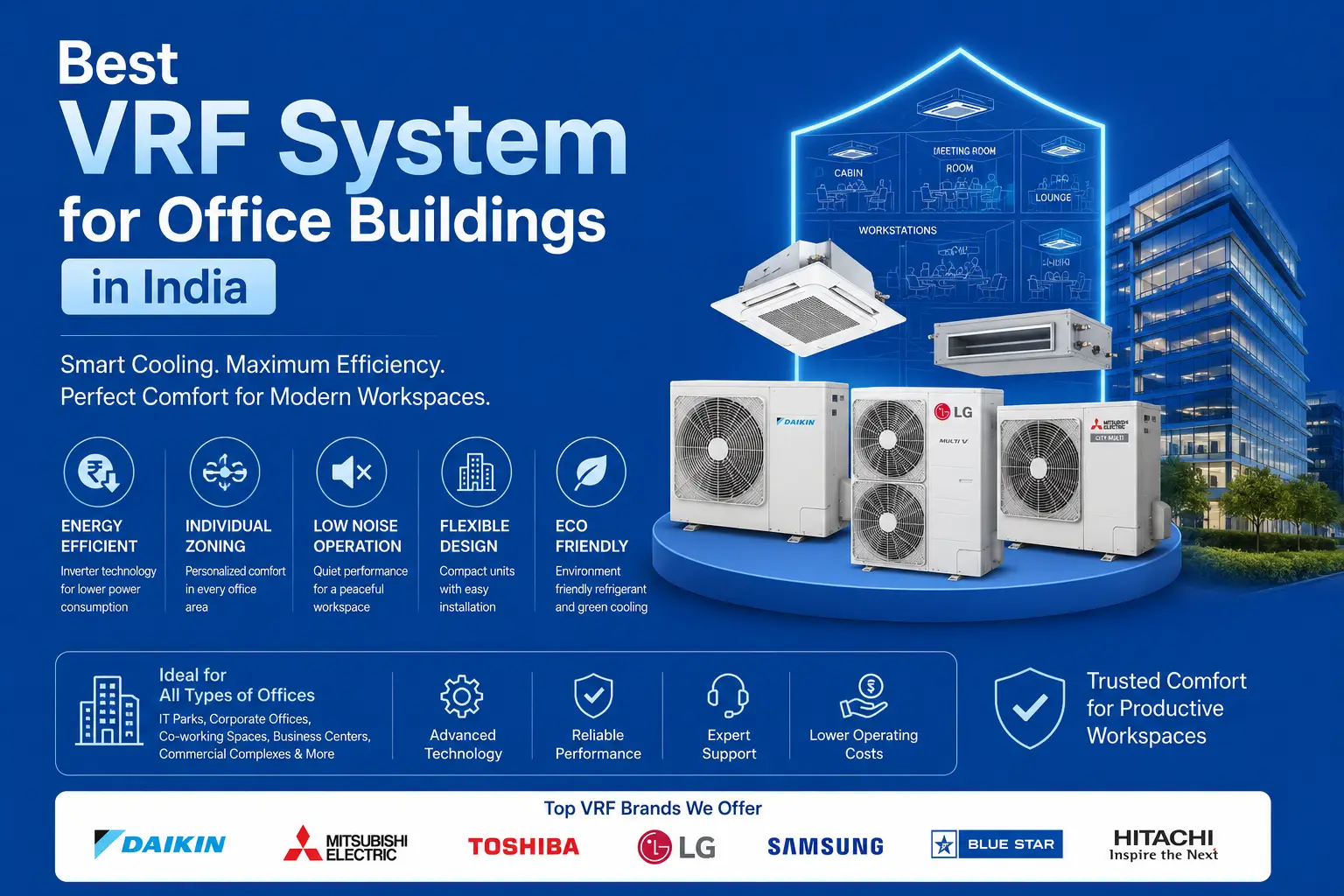
Best VRF System for Office Buildings in India
Modern office buildings in India require intelligent air conditioning systems that provide superior comfort, lower electricity bills, flexible zoning, smart controls, and long-term reliability. Traditional centralized HVAC systems are gradually being replaced by Variable Refrigerant Flow systems because of their exceptional energy efficiency and operational flexibility.
From IT parks and commercial towers to co-working spaces and corporate headquarters, VRF technology has become the preferred HVAC solution for premium office infrastructure across India.
If you are planning HVAC installation for a commercial office building, this detailed guide will help you choose the best VRF system in India based on energy efficiency, cooling performance, smart features, installation flexibility, maintenance, operating cost, and long-term return on investment.
What is a VRF System?
VRF stands for Variable Refrigerant Flow. It is an advanced HVAC technology that adjusts refrigerant flow according to the cooling or heating demand of individual indoor zones.
Unlike conventional systems where all rooms receive fixed cooling, VRF systems intelligently regulate cooling capacity depending on occupancy, heat load, and room usage.
A VRF system mainly consists of:
- Outdoor condensing units
- Multiple indoor units
- Refrigerant piping network
- Intelligent controllers
- Building management integration
VRF systems are ideal for:
- Office buildings
- IT parks
- Commercial towers
- Banks
- Corporate offices
- Hospitals
- Hotels
- Educational institutions
- Retail showrooms
- Co-working spaces
Why VRF Systems are Best for Office Buildings
Office buildings have varying cooling requirements throughout the day. Conference rooms, cabins, open offices, server rooms, reception areas, cafeterias, and executive rooms all require different temperature settings.
VRF technology solves this challenge through individual zoning.
Key Benefits of VRF for Offices
1. Energy Efficiency
VRF systems use inverter compressors that operate according to actual cooling demand. This reduces electricity consumption significantly.
2. Individual Temperature Control
Every room or zone can have independent temperature settings.
3. Lower Operating Cost
Reduced power consumption lowers monthly electricity bills.
4. Flexible Installation
Long refrigerant piping makes VRF suitable for large office buildings.
5. Quiet Operation
VRF indoor units produce minimal noise, making them perfect for office environments.
6. Space Saving
No large ducting requirement like centralized chilled water systems.
7. Smart Automation
Modern VRF systems support:
- Wi-Fi controls
- BMS integration
- Energy monitoring
- Remote diagnostics
- Cloud management
8. Simultaneous Cooling and Heating
Heat recovery VRF systems can cool one zone while heating another.
VRF vs VRV: What is the Difference?
Many people get confused between VRF and VRV systems.
Technically, both technologies are almost identical.
- VRF = Variable Refrigerant Flow
- VRV = Variable Refrigerant Volume
VRV is a trademark term used by Daikin.
All other manufacturers use the term VRF.
In practical commercial HVAC applications, both terms refer to advanced inverter-based multi-zone air conditioning systems.
Types of VRF Systems for Office Buildings
Heat Pump VRF System
Provides either cooling or heating at one time.
Best for:
- Small offices
- Medium commercial buildings
- Co-working spaces
Heat Recovery VRF System
Can provide simultaneous cooling and heating.
Best for:
- Large corporate offices
- Premium commercial towers
- Hotels
- Multi-zone buildings
Water-Cooled VRF
Uses water loop systems for heat rejection.
Best for:
- High-rise buildings
- Green buildings
- LEED-certified projects
Best VRF System for Office Buildings in India
1. Daikin VRV System
Daikin is considered one of the best VRF manufacturers globally and dominates the Indian commercial HVAC market.
Advantages of Daikin VRV
- Excellent energy efficiency
- Highly reliable compressors
- Strong service network in India
- Advanced inverter technology
- Intelligent controls
- Low noise operation
- Superior long piping capability
Best Daikin VRV Series
- Daikin VRV X
- Daikin VRV A Series
- Daikin VRV 5 Heat Recovery
- Daikin Mini VRV
Ideal Applications
- Corporate offices
- IT parks
- Commercial towers
- Premium office spaces
Why Offices Prefer Daikin
Daikin systems offer superior operational stability, advanced controls, and low lifecycle cost.
Many multinational companies in India prefer Daikin VRV because of:
- Reliability
- Energy savings
- Better after-sales support
- BMS compatibility
2. Mitsubishi Electric VRF System
Mitsubishi Electric is globally recognized for premium HVAC technology and high-performance VRF systems.
Advantages
- Extremely energy efficient
- Excellent compressor reliability
- Advanced inverter control
- Quiet indoor units
- Superior comfort control
Popular Series
- CITY MULTI VRF
- Y Series
- R2 Series
- Hybrid VRF
Best for
- Luxury office projects
- Green buildings
- Data centers
- Smart office infrastructure
Why Mitsubishi is Premium
Mitsubishi Electric VRF systems are known for:
- Long lifespan
- Precise temperature control
- Low breakdown rates
- Excellent performance in harsh climates
3. Toshiba VRF System
Toshiba VRF systems are widely used in commercial projects due to their reliability and advanced Japanese engineering.
Advantages
- High seasonal efficiency
- Compact outdoor units
- Flexible piping design
- Excellent inverter technology
- Reliable compressors
Popular Models
- Toshiba SMMS-u
- Toshiba Mini SMMS
- Toshiba SHRMi
Ideal Applications
- Mid-size office buildings
- Commercial spaces
- IT offices
- Educational institutions
4. Carrier VRF System
Carrier is one of the oldest HVAC brands and offers high-quality VRF solutions for commercial applications.
Advantages
- Strong commercial HVAC expertise
- Reliable operation
- Smart controls
- Good energy efficiency
- Excellent project support
Popular Carrier VRF Series
- XPower VRF
- AquaSnap integration
- Toshiba-Carrier VRF
Best Applications
- Corporate offices
- Banks
- Government buildings
- Commercial complexes
5. LG Multi V VRF System
LG Multi V systems are becoming increasingly popular in India due to competitive pricing and smart features.
Advantages
- AI-based optimization
- Smart diagnostics
- Energy management
- Competitive installation cost
- Compact design
Popular Series
- LG Multi V 5
- LG Multi V i
- LG Multi V S
Best for
- Medium office buildings
- Co-working spaces
- Commercial offices
- Retail applications
6. Samsung DVM S VRF System
Samsung VRF systems offer advanced digital control and modern smart HVAC features.
Advantages
- AI technology
- Smart controls
- Compact installation
- Modern interface
- Energy monitoring
Best Applications
- Smart offices
- Technology companies
- Startups
- Modern commercial buildings
7. Hitachi VRF System
Hitachi offers durable VRF systems suitable for Indian climate conditions.
Advantages
- Reliable compressors
- Stable cooling
- Long equipment life
- Good energy efficiency
- Competitive pricing
Best Applications
- Mid-size offices
- Commercial buildings
- Educational institutions
8. Blue Star VRF System
Blue Star is one of India’s leading HVAC brands and provides cost-effective VRF solutions.
Advantages
- Strong Indian market presence
- Good service support
- Competitive pricing
- Commercial HVAC expertise
Best for
- Budget-conscious commercial projects
- Medium office spaces
- Retail buildings
- Indian commercial infrastructure
Comparison of Top VRF Brands in India
| Brand | Energy Efficiency | Reliability | Service Network | Best For |
|---|---|---|---|---|
| Daikin | Excellent | Excellent | Excellent | Premium office buildings |
| Mitsubishi Electric | Excellent | Excellent | Very Good | Luxury projects |
| Toshiba | Very Good | Excellent | Good | Mid-size offices |
| Carrier | Very Good | Very Good | Very Good | Commercial buildings |
| LG | Very Good | Good | Good | Smart offices |
| Samsung | Good | Good | Good | Modern office spaces |
| Hitachi | Very Good | Very Good | Good | Medium offices |
| Blue Star | Good | Good | Excellent | Budget projects |
Factors to Consider Before Choosing Best VRF System for Office Buildings in India
1. Building Size
The total built-up area directly affects system selection.
Small Offices
Suitable for:
- Mini VRF
- Compact systems
- Single outdoor unit solutions
Medium Commercial Buildings
Need:
- Modular VRF systems
- Multiple indoor zones
- Centralized controls
Large Commercial Towers
Require:
- Heat recovery VRF
- Advanced BMS integration
- High-capacity modular systems
2. Energy Efficiency Ratings
Always evaluate:
- IPLV
- COP
- EER
- Seasonal efficiency
Higher efficiency means lower electricity bills.
3. Piping Flexibility
Long refrigerant piping capability is important for office towers.
Look for:
- High vertical separation
- Long total piping length
- Flexible branch connections
4. Indoor Unit Options
Office buildings require different indoor units:
- Cassette AC
- Ducted units
- Wall-mounted units
- Floor-standing units
- Ceiling suspended units
5. Building Management System Integration
Modern office buildings require integration with:
- BMS systems
- Fire alarm systems
- Energy monitoring
- Access control systems
6. Service Support
Commercial HVAC systems need reliable after-sales support.
Check:
- Local dealer network
- Spare part availability
- AMC services
- Technical expertise
Best VRF System Based on Office Type
Best VRF for IT Offices
Recommended:
- Daikin VRV
- Mitsubishi Electric CITY MULTI
- Toshiba SMMS
Why?
- High reliability
- Continuous operation capability
- Better humidity control
- Precise cooling
Best VRF for Co-Working Spaces
Co-working spaces require HVAC systems that provide flexible zoning, low operating cost, smart controls, quiet operation, and energy efficiency. Since occupancy changes throughout the day, VRF systems are ideal because they can adjust cooling capacity dynamically for meeting rooms, hot desks, cabins, cafeterias, and shared office areas.
The best VRF systems for co-working spaces should offer:
- Individual temperature control
- Smart energy management
- Quiet indoor operation
- Easy scalability
- Compact installation
- Low maintenance cost
- Wi-Fi and centralized control support
1. LG Multi V – Best Smart VRF for Flexible Co-Working Offices
LG Multi V systems are highly popular for modern co-working environments because of their AI-based optimization and smart control features.
Why Recommended
- Smart occupancy optimization
- Energy-efficient inverter compressors
- Compact outdoor units
- Advanced monitoring system
- Easy expansion for growing office spaces
- Competitive commercial pricing
Best Applications
- Shared office spaces
- Startup hubs
- Managed office buildings
- Medium-sized co-working floors
Popular Models
- LG Multi V 5
- LG Multi V S
2. Daikin VRV – Best Overall Premium VRF System
Daikin VRV systems are among the most reliable commercial HVAC solutions in India.
Why Recommended
- Exceptional energy efficiency
- Superior zoning capability
- Long operational life
- Strong service network across India
- Advanced BMS integration
- Excellent cooling stability during peak occupancy
Best Applications
- Premium co-working brands
- Multi-floor office hubs
- Corporate shared workspaces
- Large commercial buildings
Popular Models
- Daikin VRV X
- Daikin VRV A Series
- Daikin Mini VRV
3. Samsung DVM S – Best for Smart & Modern Workspaces
Samsung VRF systems are suitable for tech-enabled office environments with smart automation requirements.
Why Recommended
- AI-powered energy management
- Modern touch control interface
- Smart diagnostics
- Compact installation
- Cloud-based monitoring
Best Applications
- Technology startups
- Modern shared offices
- Smart commercial buildings
- Creative office environments
4. Blue Star VRF – Best Budget Commercial VRF
Blue Star offers economical VRF systems suitable for Indian co-working projects with budget constraints.
Why Recommended
- Competitive installation cost
- Strong Indian service support
- Reliable commercial performance
- Good spare parts availability
Best Applications
- Budget-friendly co-working spaces
- Tier-2 city office projects
- Small commercial office buildings
5. Mitsubishi Electric CITY MULTI – Best Premium Comfort VRF
Mitsubishi Electric is known for precision cooling and extremely quiet operation.
Why Recommended
- Superior comfort control
- Very low indoor noise
- Excellent energy savings
- Long equipment lifespan
- Premium Japanese engineering
Best Applications
- Luxury co-working spaces
- Executive office hubs
- Premium business centers
- Green-certified office projects
Best VRF System Comparison for Co-Working Spaces
| Feature | Daikin VRV | LG Multi V | Samsung DVM S | Mitsubishi CITY MULTI | Blue Star VRF |
|---|---|---|---|---|---|
| Energy Efficiency | Excellent | Very Good | Very Good | Excellent | Good |
| Smart Controls | Excellent | Excellent | Excellent | Very Good | Good |
| Installation Flexibility | Excellent | Very Good | Very Good | Excellent | Good |
| Service Network in India | Excellent | Good | Good | Very Good | Excellent |
| Best For | Premium offices | Flexible shared offices | Smart workspaces | Luxury offices | Budget projects |
| Operating Cost | Low | Low | Moderate | Low | Moderate |
| Noise Level | Very Low | Low | Low | Extremely Low | Moderate |
Which VRF System is Best for Co-Working Spaces in India?
Best Overall
Daikin VRV is the best overall choice for large and premium co-working office spaces because of its reliability, energy savings, and advanced zoning capability.
Best Smart HVAC Choice
LG Multi V is ideal for modern flexible workspaces needing AI optimization and smart control.
Best Premium Comfort
Mitsubishi Electric CITY MULTI is excellent for luxury shared office projects requiring silent operation and premium comfort.
Best Budget Option
Blue Star VRF is suitable for cost-sensitive co-working projects in India.
Important HVAC Design Tips for Co-Working Spaces
- Use separate zoning for meeting rooms and open seating
- Install fresh air ventilation systems
- Use occupancy-based controls for energy savings
- Include centralized monitoring for facility managers
- Select low-noise indoor cassette units
- Perform accurate heat load calculations before selection
- Plan future expansion capacity during design stage
Final Conclusion
Co-working spaces require HVAC systems that can adapt quickly to changing occupancy patterns while maintaining comfort and reducing electricity costs.
For most commercial co-working projects in India:
- Daikin VRV remains the best premium commercial solution
- LG Multi V offers the best smart office flexibility
- Mitsubishi Electric CITY MULTI delivers superior comfort and reliability
- Blue Star VRF provides cost-effective commercial HVAC performance
The final selection should always depend on:
- Building size
- Occupancy pattern
- Budget
- Fresh air requirement
- Smart automation needs
- Long-term operational cost
- Local service support
FAQ – Best VRF System for Office Buildings in India
What is a VRF system in office buildings?
A VRF (Variable Refrigerant Flow) system is an advanced commercial HVAC technology that provides individual temperature control for multiple office zones using a single outdoor unit and multiple indoor units.
Which is the best VRF system brand in India for office buildings?
Popular VRF brands in India include Daikin, Mitsubishi Electric, Toshiba, Carrier, LG, and Blue Star. The best choice depends on budget, building size, and energy-saving requirements.
Why are VRF systems suitable for office buildings?
VRF systems are ideal for offices because they provide:
- Energy efficiency
- Individual room control
- Quiet operation
- Flexible installation
- Smart automation
- Lower operating costs
- Better comfort management
What is the difference between VRF and VRV?
VRF means Variable Refrigerant Flow, while VRV means Variable Refrigerant Volume. Both technologies work similarly. VRV is a trademark term used by Daikin.
Is VRF better than centralized air conditioning for offices?
In many office applications, VRF systems are more energy efficient and flexible than traditional centralized HVAC systems because they support zoning and inverter-based operation.
Which VRF system is best for IT office buildings?
For IT offices and commercial workspaces, Daikin VRV, Mitsubishi Electric CITY MULTI, and Toshiba SMMS systems are widely preferred.
How much electricity can a VRF system save?
A properly designed VRF system can reduce energy consumption by approximately 20% to 40% compared to conventional commercial air conditioning systems.
What is the lifespan of a VRF system?
A commercial VRF system can typically last 12 to 20 years with proper maintenance and professional servicing.
Is VRF suitable for small office spaces?
Yes. Mini VRF systems are available for small and medium office spaces, startups, and co-working environments.
Which indoor unit is best for office VRF systems?
Cassette indoor units are commonly used in office buildings because they provide uniform airflow and clean aesthetics. Concealed ducted units are preferred for premium interiors.
Can VRF systems handle multiple office zones?
Yes. One of the biggest advantages of VRF systems is individual zoning control, allowing different office areas to maintain different temperatures.
What is heat recovery VRF?
Heat recovery VRF systems can cool one zone while heating another simultaneously, improving energy efficiency in large commercial buildings.
Are VRF systems expensive?
VRF systems usually have higher initial installation costs than split AC systems, but they offer lower electricity bills and reduced operational costs over time.
What factors affect VRF system cost in India?
VRF pricing depends on:
- Building size
- Cooling capacity
- Brand selection
- Indoor unit quantity
- Piping length
- Controls and automation
- Installation complexity